



Drupal AI Summit 2025: What Speakers Will Address on AI, Governance and Drupal’s Future

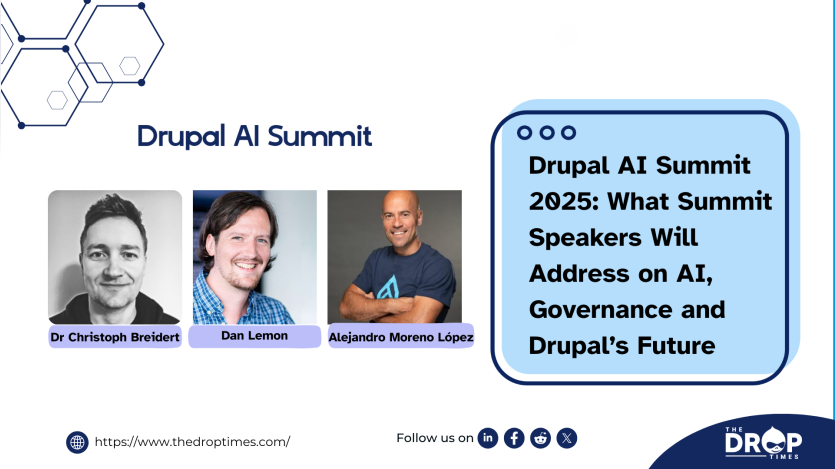
Technology leaders and open-source practitioners from several regions will gather in Paris on 9 December 2025 for the Drupal AI Summit, held within FOST, a federated technology conference. The one-day summit includes eleven expert-led sessions examining practical AI architecture, emerging development models, and the experiences of teams building open-source AI tooling at scale.
A core focus of the summit is how organisations can apply AI to specific business requirements using open-source systems that support digital sovereignty, governance, and responsible implementation. The programme is designed around practical demonstrations and informed discussion, offering participants an opportunity to examine approaches grounded in current practice rather than short-term trends. For teams assessing how AI may influence their digital operations, the summit provides a structured space to review methods already being tested in production environments.
As part of The Drop Times' coverage, we contacted several speakers to learn more about the subjects they will present and the perspectives they will bring to the event.
In this article, we cover Alejandro Moreno López, Dan Lemon and Dr Christoph Breidert.
Alejandro Moreno López - Pantheon Platform

Alejandro Moreno López is Partner Manager and Developer Relations at Pantheon Platform. His session, "Orchestrating AI with an open-source CMS: How Drupal powers the future of APIs & AI," examines how Drupal's architecture supports emerging AI workflows and the orchestration of API-driven systems.
TDT[1]: What will you be presenting at the Drupal AI Summit, and what should attendees expect to learn from your session?
Alejandro Moreno López: We have a unique opportunity to showcase Drupal to a wider, non-Drupal audience. My goal is to provide a high-level overview of what Drupal really is today, how it has evolved over the years, and how, almost unexpectedly, it has become the perfect orchestration tool for the AI era. I will also be showcasing specific AI CMS capabilities that demonstrate this power. This includes the sponsored work Pantheon has achieved in collaboration with partners, such as the Gemini integration with Giorgi Jibladze from Omedia, and the Tool API work with Michael Lander from Elevated Third. Attendees will see real-world examples of how open source collaboration is driving AI innovation.
TDT[2]: With so many AI tools and agent frameworks growing fast, what do you hope people understand about Drupal's place in this AI ecosystem and what they can take back to their own teams?
Alejandro Moreno López: The expected audience is not necessarily technical, Drupal-savvy, or even programmers, and that is perfect. Many of us got into Drupal, and into programming, thanks to the low-code and no-code capabilities of our framework. People came to Drupal not because it was easy, but because it was incredibly flexible and powerful for building cool things.
I believe the future of Drupal lies in its past. If we understand how we became so popular, we can return to that golden era. We need to stop trying to appeal to everyone and instead specialise even further in building amazing tools for builders. Crucially, AI agents require structured context to function effectively, not just flat text. Drupal's fundamental architecture is built on structured data, which makes it uniquely qualified to feed these agents the clean, organised information they need to be accurate.
TDT[3]: Is your upcoming session primarily technical? Could you also outline the key value it offers to end users, business owners, or other stakeholders? This will help us present it accurately in our event promotion.
Alejandro Moreno López: I intend to spread the word beyond the "Drupal Bubble," so the perfect audience for this is actually non-technical stakeholders, or technical leaders who want to know more about what Drupal can do. For business owners and end users, the key value is understanding how an open platform provides a competitive advantage in the AI age. We will address the risk of vendor lock-in, as the AI landscape changes weekly. By using an open platform like Drupal, business owners retain the freedom to swap out LLMs or agents as new models emerge. It is about showing that you don't need a black-box proprietary solution to build intelligent digital experiences; you can do it faster and more flexibly with the open web.
Dan Lemon - amazee.io

Dan Lemon is a Software Engineer at amazee.io. In his session, "Private & Secure AI: A data sovereign, compliant solution for your team," he outlines approaches for running AI workloads in controlled environments that meet compliance and data-sovereignty requirements.
TDT[1]: What will you be presenting at the Drupal AI Summit, and what should attendees expect to learn from your session?
Dan Lemon: I'll be presenting "Private & Secure AI: A data sovereign, compliant solution for your team." It is a case study on how we built our own "Private AI Assistant" SaaS product. Attendees can expect a blueprint for building privacy-first AI. I'll demonstrate how we use Drupal as our core governance engine.
Participants will learn to leverage Drupal's User Management and Role-Based Access Control (RBAC) to ensure isolation. I will walk through our architecture, combining the Drupal AI ecosystem, Search API for RAG, GraphQL, LangChain, ChainLit, and Lagoon to construct a fully compliant tool.
TDT[2]: With so many AI tools and agent frameworks growing fast, what do you hope people understand about Drupal's place in this AI ecosystem and what they can take back to their own teams?
Dan Lemon: I hope people understand that Drupal has always been a framework for governance, and that building a SaaS with Drupal and AI is a great combination. Many agent frameworks excel at text generation but struggle with enterprise requirements like permissions, audit trails, and session management.
My message is that teams do not need to reinvent the wheel by building custom auth systems; Drupal provides all of this out of the box. I want developers to treat Drupal as the policy engine for their AI stack. This approach allows them to build applications that are significantly safer and easier to audit than if they were built from scratch.
TDT[3]: Is your upcoming session primarily technical? Could you also outline the key value it offers to end users, business owners, or other stakeholders? This will help us present it accurately in our event promotion.
Dan Lemon: Whilst the session covers technical architecture, the core value is for business owners and stakeholders seeking private AI solutions.
For Stakeholders: It addresses how to deploy AI without leaking IP or violating GDPR. I explain how this architecture solves compliance issues through strict data isolation.
For End Users: It provides a ChatGPT-like tool that is safe to use with sensitive internal documents and HR data.
Dr Christoph Breidert - S1x Signals Framework / AIO / GEO

Dr Christoph Breidert will present "AIO / GEO - Content optimisation with AI for AI." He introduces the S1x Signals Framework, a method for Artificial Intelligence Optimisation and Generation Engine Optimisation, focusing on preparing Drupal content for visibility in AI-generated search results and automating audits to keep content AI-ready.
TDT[1]: What will you be presenting at the Drupal AI Summit, and what should attendees expect to learn from your session?
Dr Christoph Breidert: I will be introducing the S1x Signals Framework, a comprehensive approach to AIO (Artificial Intelligence Optimisation) and GEO (Generation Engine Optimisation).
As website traffic patterns shift - often declining as users get answers directly from AI - it is critical that when AI generates an answer, it does so in our favor. Attendees will learn the six specific "signals" necessary to make content ready for the AI era:
Citation Readiness Query Alignment Content Structure & Formatting Authority & Trust Signals Semantic Clarity & Entity Recognition Technical Accessibility
Basically, I will show how to move beyond traditional SEO goals (ranking on page one) to GEO goals (getting cited in AI answers).
TDT[2]: With so many AI tools and agent frameworks growing fast, what do you hope people understand about Drupal's place in this AI ecosystem and what they can take back to their own teams?
Dr Christoph Breidert: I hope to demonstrate that while "Content is King, Context is King Kong".
LLMs generate answers based on training data and context. Drupal plays a vital role here because it is excellent at providing that structured context. It's not just about the text on the page; it's about schema markup, entity recognition, and semantic clarity.
I want teams to understand that they can use Drupal to automate content audits against these six signals. By ensuring Drupal outputs clean, structured, and legally accessible data (like correct robots.txt and sitemaps), we essentially "feed" the AI agents the right information.
TDT[3]: Is your upcoming session primarily technical? Could you also outline the key value it offers to end users, business owners, or other stakeholders?
Dr Christoph Breidert: It is a hybrid session that bridges the gap between marketing strategy and technical implementation.
For Technical Teams: We will cover technical accessibility, such as implementation of `/llms.txt`, valid XML sitemaps, and schema.org markup types (Article, FAQ Page, Organisation, etc.).
For Business Owners & Marketers: The framework is fundamentally about protecting brand visibility. It ensures that a company's core value propositions and key differentiators are clearly understood and cited by AI. It treats AIO as a natural evolution of traditional marketing, helping you provide information in a way that AI can process and trust.
 Kazima AbbasKazima Abbas is a sub-editor at The Drop Times
Image Attribution Disclaimer: At The Drop Times (TDT), we are committed to properly crediting photographers whose images appear in our content. Many of the images we use come from event organizers, interviewees, or publicly shared galleries under CC BY-SA licenses. However, some images may come from personal collections where metadata is lost, making proper attribution challenging.
Our purpose in using these images is to highlight Drupal, its events, and its contributors—not for commercial gain. If you recognize an image on our platform that is uncredited or incorrectly attributed, we encourage you to reach out to us at #thedroptimes channel on Drupal Slack.
We value the work of visual storytellers and appreciate your help in ensuring fair attribution. Thank you for supporting open-source collaboration!
ASK: Drupal Community Needs Your Support
View all →
Disclosure: This content is produced with the assistance of AI.
Note: The vision of this web portal is to help promote news and stories around the Drupal community and promote and celebrate the people and organizations in the community. We strive to create and distribute our content based on these content policy. If you see any omission/variation on this please reach out to us at #thedroptimes channel on Drupal Slack and we will try to address the issue as best we can.

Related Drupal Initiatives

Related Events


Related Organizations


Related People


You may also like