



DrupalCon Vienna 2025: Navigating the Storm


Dries took the stage in Vienna today with a message that hit right at the heart of where the web is heading. His keynote, titled “The Map of the Web is Being Redrawn,” was as much a reflection on change as it was a challenge to the community to embrace what is coming next.
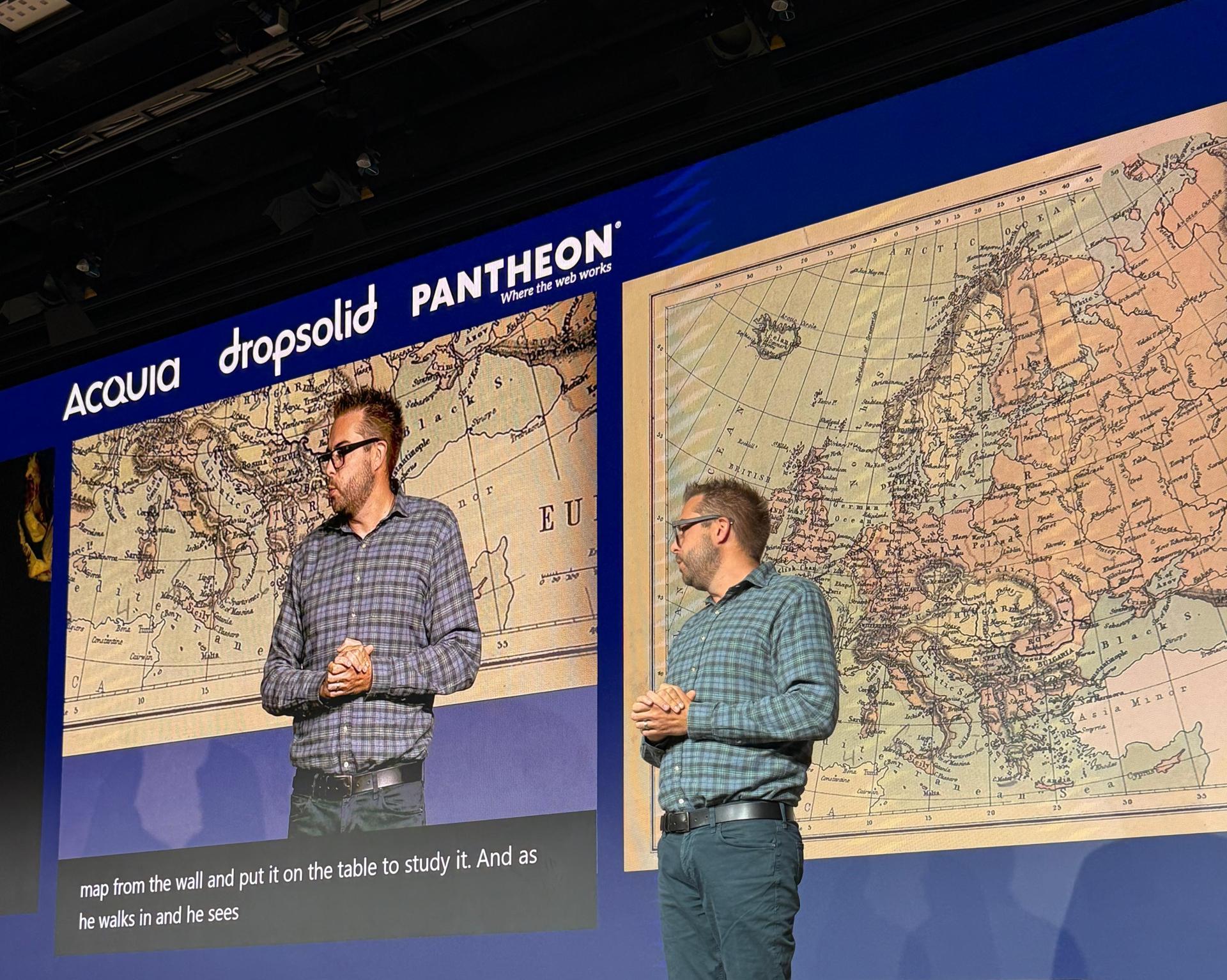
He started with history, a map, a battle, a quote, then drew a line from those moments of transformation to what we are living through now. Artificial intelligence, he said, is not just another wave of innovation. It is a storm that is already reshaping everything, how we search, how we create, how we build for the web.
We have built our websites in a search engines era. Like in Europe during those stormy, war times, maps are being rebuilt. “A new map is needed.” But far from sending a pessimistic message and talking about bubbles, in Dries’ words, the commercial bubble will burst, but the technology will persist.
More than two-thirds of all searches now end in zero clicks. If AI keeps giving people direct answers, the question becomes, why build websites at all? It is the kind of provocation only Dries can make in a room full of web developers. But instead of leaving it there, he offered direction: “AI is the storm, and the way through it.”
From Starshot to Canvas
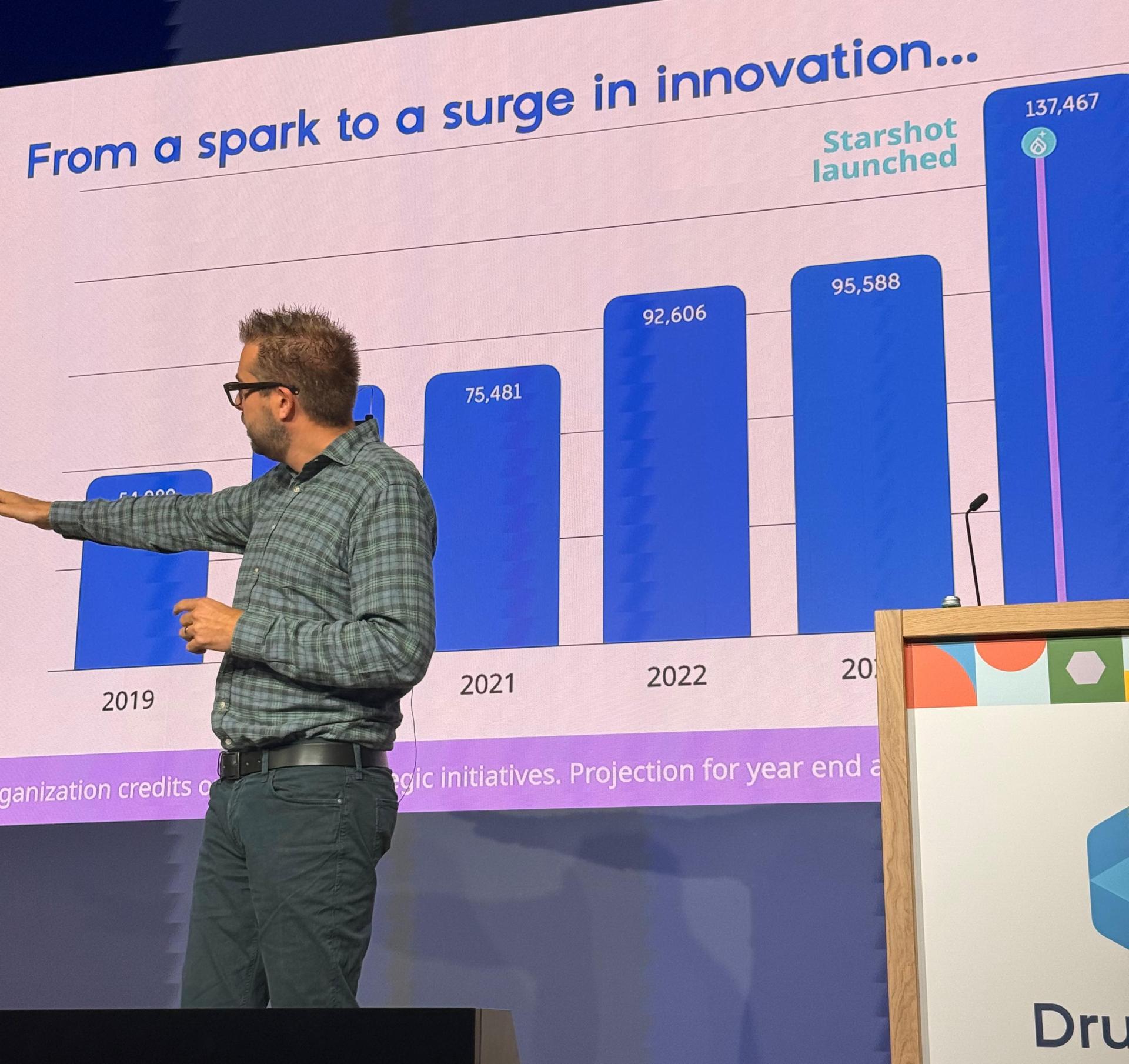
If the first part of the keynote was about the storm, the second was about the tools to face it. The past two years have been some of the most productive in Drupal’s history. Contributions have doubled since 2023, and Starshot has clearly done its job of sparking a new wave of innovation.
That energy is now flowing into Drupal Canvas, a visual, no-code way to build sites in Drupal. It is designed to make site creation faster and more intuitive, without losing the flexibility that defines Drupal. Canvas combines site templates, recipes, and a new theme and design system called Mercury into a unified experience that lets users go from setup to launch in minutes.
Canvas 1.0 is coming in November 2025, and it introduces several key features. Content Templates will allow editors to define reusable content structures, simplifying how pages and layouts are built. Code Components will bridge the gap between Drupal and modern JavaScript frameworks, enabling front-end developers to extend Drupal visually while keeping clean, structured code behind the scenes.
A Figma-to-Canvas prototype was also previewed, showing an integrated “design-to-code” workflow where Figma designs can be brought directly into Drupal. This connects designers and developers more closely, opening a true collaborative path from concept to production.
Canvas will play a central role in the new Site Template Marketplace, making it possible for creators to design, export, and share site templates. The Marketplace, which Dries confirmed has been officially green-lit, will allow agencies and designers to distribute ready-to-go templates to speed up project delivery. A site template export feature is in development to support this workflow and open participation to the entire community.
Finally, the keynote showed how AI will complement Canvas, helping users generate relevant content and layouts automatically while keeping full control inside Drupal. The combination of Canvas and AI tools is intended to lower the barriers to entry for new users without removing the depth and flexibility that experienced developers rely on.
Together, these innovations position Canvas as much more than a new site builder. It represents a rethinking of how Drupal can serve creators, designers, and developers in the next era of the open web.
AI, the Drupal Way
Another strong theme was AI, but framed through Drupal’s values. The Drupal AI Initiative has already raised $1 million in five months, with Dominique De Cooman playing a leading role in organizing contributors and expanding its reach. It is starting to deliver practical results: AI page generation, a Context Control Center to make content more relevant based on our instructions like target persona or brand voice, and even autonomous Drupal agents that take initiative without waiting for user prompts following the design brand.
Dries made it clear that this is not about chasing trends. It is about building AI the Drupal way — open, transparent, and in service of creators and site developers, not just end users.
Beyond the CMS
The keynote also introduced Orchestration, a new Drupal initiative that connects Drupal with external automation platforms. It builds on Drupal’s Event-Condition-Action (ECA) system, allowing Drupal to trigger or respond to actions in other tools without writing custom code.
The module is already available on Drupal.org and works with ActivePieces, an open-source automation platform that competes with n8n and Zapier, and has more than 450 integrations. It enables workflows such as migrating content from WordPress, updating external systems when content changes in Drupal, or triggering Drupal events from other services. Dries actually showed how easy it was to migrate a WordPress site to Drupal. It even used ChatGPT to Drupify content from ma.tt, a known WordPress site that may be familiar to some. And this Orchestration is just scratching the surface of how powerful this can be.
By combining Orchestration with Drupal’s existing ECA capabilities, site builders can create automated processes that span multiple tools and services. Again, hundreds of internal actions are already supported, from node updates and user creation to form submissions, with more external integrations on the way.
Dries presented Orchestration as part of a broader vision to make Drupal not only a content management system but also a hub for automation and integration within the open web.
Looking Ahead
Dries wrapped up with a roadmap that stretches well into 2026:
- Drupal Canvas 1.0 in November 2025
- Drupal CMS 2.0 in January 2026
- Marketplace MVP soon after, with more templates coming
- Drupal CMS 3.0, focusing on adoption, accessibility, and easier hosting
There is even a community celebration planned to mark the milestones before a bigger marketing push. It feels like the project is getting ready to show the world what Drupal has become — not just a CMS, but a foundation for the next generation of digital experiences.
A Message of Optimism
For all the talk of AI disruption, the keynote ended on a reassuring note. “Websites still matter. Agencies still matter,” Dries said. We will always need trusted spaces where ownership, identity, and creativity live. AI might change how we get there, but it does not replace the need for what we build.
In a world where content is generated faster than ever, Drupal’s strength — its structure, openness, and community — might be exactly what the web needs most.
And as always, Dries reminded us, we have navigated uncharted territory before.
Written by Alex Moreno, Partner Manager at Pantheon and Member of the Board of Directors at the Drupal Association for The Drop Times
 Alejandro Moreno LópezPartner Manager at Pantheon and a member of the Board of Directors at the Drupal Association
Image Attribution Disclaimer: At The Drop Times (TDT), we are committed to properly crediting photographers whose images appear in our content. Many of the images we use come from event organizers, interviewees, or publicly shared galleries under CC BY-SA licenses. However, some images may come from personal collections where metadata is lost, making proper attribution challenging.
Our purpose in using these images is to highlight Drupal, its events, and its contributors—not for commercial gain. If you recognize an image on our platform that is uncredited or incorrectly attributed, we encourage you to reach out to us at #thedroptimes channel on Drupal Slack.
We value the work of visual storytellers and appreciate your help in ensuring fair attribution. Thank you for supporting open-source collaboration!
ASK: Drupal Community Needs Your Support
View all →
Note: The vision of this web portal is to help promote news and stories around the Drupal community and promote and celebrate the people and organizations in the community. We strive to create and distribute our content based on these content policy. If you see any omission/variation on this please reach out to us at #thedroptimes channel on Drupal Slack and we will try to address the issue as best we can.
Related Events



Related Organizations

Related People


You may also like