


The “Lego Set” for the AI Era: Inside Cetacean Labs’ Oceanic Platform

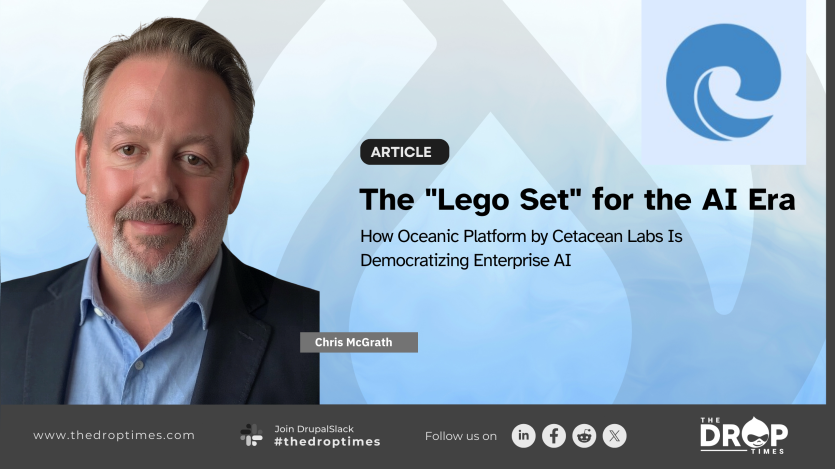
When Dries Buytaert change made the analogy of Drupal Recipes to Legos at DrupalCon Atlanta 2025, the comparison resonated because it captured what Drupal has always done best: it turned complexity into something buildable. Drupal did not eliminate the hard parts of web development. It modularized them, standardized them, and made them composable, so that teams could assemble enterprise-grade outcomes using predictable building blocks rather than custom engineering every time.
Now, Drupal veteran Chris McGrath is applying that same builder philosophy to a new frontier: AI-enabled web applications and infrastructure. In the same way Drupal and Acquia provided the building blocks to assemble web content management and secure deployment without starting from scratch, McGrath’s company, Cetacean Labs, is positioning its Oceanic Platform as a curated “Lego set” of AI building blocks that snap together cleanly to form enterprise-grade solutions without writing code.
The promise is straightforward and ambitious. Instead of treating AI as a bespoke engineering discipline that requires specialist teams, Oceanic treats AI systems as assemblies.
Users state intent, and the platform composes the required components to deliver secure, AI-native platforms or micro-purpose-driven applications in minutes rather than months. The platform is positioned as a no-code AI assembly kit, grounded in the same philosophy that made Drupal modular, community-driven, and scalable.
Users state intent, and the platform composes the required components to deliver secure, AI-native platforms or micro-purpose-driven applications in minutes rather than months.
The Drupal Parallel
The parallel is explicit. Drupal offered modular architecture, hooks, contributed modules, and community-driven development. Oceanic offers modular AI components, plug-and-play blocks, a curated small language model library, drop-in enterprise intelligence, and open-source foundations. The shared intent is the democratization of complex technology so non-specialists can build production-grade solutions.
Assembling AI Micro-Apps
At the center of Oceanic is the Oceanic Intelligent App Builder, designed to abstract away what many organizations find intimidating about AI: cloud infrastructure, vector databases, and model tuning. Instead of forcing users to make low-level decisions, the system presents interoperable functional blocks that fit together. A user can simply type, “Build an AI-driven intranet for my hospital network,” and the platform autonomously selects and snaps together the necessary parts across intelligence, memory, reasoning, training, and action.
Intelligence is delivered through Blue Whale, a curated library of domain-specific small language models spanning Legal, Medical, Financial, Logistics, Manufacturing, and Real Estate. These models are ten to one hundred times faster and cheaper than generic models. The platform also supports auto-detection, identifying the domain from natural language and recommending the optimal model. Blue Whale distinguishes between Models, which provide knowledge and expertise, and Skills, which represent tools and actions.
Memory and data access are delivered through Echo, the platform’s universal retrieval-augmented generation layer. Echo includes twenty pre-configured connectors with more than 1,280 additional connectors available via Airbyte and LlamaHub, both MIT licensed. It supports natural language and voice search, including queries such as “Hey Echo, find all Q3 budget reports,” along with multi-modal ingestion across documents, images, video, and audio. Echo delivers twenty-three percent better accuracy than vector-only approaches, supports setup in under thirty seconds with NotebookLM-style simplicity, and respects enterprise permissions through ACL-aware retrieval.
Reasoning and enterprise intelligence are delivered through Orca. Powered by SAFLA, the Self-Aware Feedback Loop Algorithm, Orca analyzes patterns, makes recommendations, and improves over time. Tasks that traditionally require eighty hours of manual research are completed in twelve minutes, delivering analysis six hundred times faster. In the DiligenceGPT partnership, Orca has demonstrated ninety-one percent accuracy.
Training is delivered through Porpoise, the platform’s no-code AI model training gateway. Porpoise offers three interfaces. Its AI Interviewer uses HeyGen video avatars to conduct natural conversations with subject matter experts, achieving a sixty-seven percent completion rate compared to twelve percent for traditional surveys. A visual workflow builder enables technical product managers to create complex workflows in fifteen minutes rather than days of coding. The Quick Train Wizard allows business users to train their first model in under thirty minutes through a four-step process. Porpoise supports invitations via Slack, Microsoft Teams, email, and SMS, delivers forty percent cost savings through multi-cloud GPU optimization across AWS, Google Cloud, and Azure, and includes more than thirty-five thousand templates from the Esteemed professional network.
Action is delivered through Dolphins, an AI agent workforce composed of eight production-ready agents: Tara (Engineer), Gemma (QA), Jax (Product Manager), Clay (Coordinator), Chibs (DevOps), Happy (Automation), Lyla (UX), and Finley (Finance). Dolphins operate in pods of three to five agents, with SuperPods scaling to thirty agents. The platform explicitly supports a trust progression ladder of Basic > Trusted > Senior > Autonomous. Dolphins deliver more than ninety percent cost savings compared to an equivalent human workforce and include built-in escalation to a global network of more than thirty-five thousand human specialists.
Curated Trust and Invisible Infrastructure
Oceanic’s value proposition is curated trust. The platform is SOC 2 Type I certified, with Type II targeted for Q4 2026. It is HIPAA-ready for healthcare deployments and compliant with GDPR and CCPA, incorporating permission-aware RAG, audit logging, and immutable compliance trails.
Infrastructure is intentionally invisible. Oceanic supports multi-cloud orchestration across AWS, Google Cloud, and Azure using Terraform infrastructure-as-code. Agentic Flow smart routing delivers forty percent infrastructure cost savings. Deployments require no DevOps engineer and can be executed with a single click across SaaS, private cloud, hybrid, or fully air-gapped on-premise environments.
Community, Marketplace, and Micro-Apps
Oceanic mirrors Drupal’s open-source and community contribution model through the Oceanic Marketplace, positioned as Drupal.org for AI. Its open-source foundations include Claude Flow, Agentic Flow, and Ruvector, all released under MIT licenses. The Marketplace enables one-click installation of models, agents, skills, and complete Blueprints such as DiligenceGPT for M&A due diligence.
Rather than purchasing monolithic enterprise software, organizations can assemble narrowly scoped micro-apps for needs such as Q4 budget analysis or new-hire onboarding. These applications are built from pre-validated components, deployed in minutes, and auditable by design.
Metrics, Validation, and Readiness
The company frames the platform around measurable operational outcomes:
The platform supports twenty pre-configured connectors with more than 1,280 additional integrations, eight production-ready AI agents, more than six domain-specific small language models, and a professional network exceeding thirty-five thousand experts. Performance metrics include six hundred times faster analysis, ninety-one percent search accuracy compared to sixty-eight percent keyword search, forty percent infrastructure cost savings, and a sixty-seven percent interview completion rate.
Validation includes a live DiligenceGPT partnership, customers such as Sony Ventures and Deloitte, a foundation built on proven MIT-licensed open source, and a full platform launch scheduled for Q1 2026.
Chris McGrath brings thirty years of enterprise IT experience with Fortune 50 clients including AT&T and Accenture. He previously founded Esteemed and Esteemed Digital, enterprise staffing and HCM solutions, and is an integral member of the Agentics Foundation management team focused on AI governance and standards.
Cetacean Labs is building the infrastructure for the autonomous economy. The Oceanic Platform combines Claude Flow, Agentic Flow, and Ruvector with enterprise-grade security and compliance to democratize access to sophisticated AI capabilities. The company’s vision is explicit: “The future is autonomous. The infrastructure is Cetacean.”
“We are providing a system that customers can think of as a set of building blocks for the application, and infrastructure layers. Whether you are a developer or a department head, you can quickly assemble an enterprise-ready AI platform or a micro-app that addresses a specific business need. Then deploy it to our cloud sitting on top of the top 3, and enterprise customers can deploy to the cloud of their choice.
Our users do not need to be experts in machine learning or cloud infrastructure; they just need to know what problem they want to solve. They trust that we have curated the latest innovations in AI and tuned the infrastructure to ensure a secure, functional outcome. This is the no-code solution for purpose-driven AI creation and flexible, cost-optimized infrastructure.”
 Alka ElizabethMy puns are intended.

ASK: Drupal Community Needs Your Support
View all →
Note: The vision of this web portal is to help promote news and stories around the Drupal community and promote and celebrate the people and organizations in the community. We strive to create and distribute our content based on these content policy. If you see any omission/variation on this please reach out to us at #thedroptimes channel on Drupal Slack and we will try to address the issue as best we can.

Related Drupal Initiatives

Related Organizations
Related People


You may also like