



12 Essential Drupal Modules for Conversational AI and Chatbot Integration

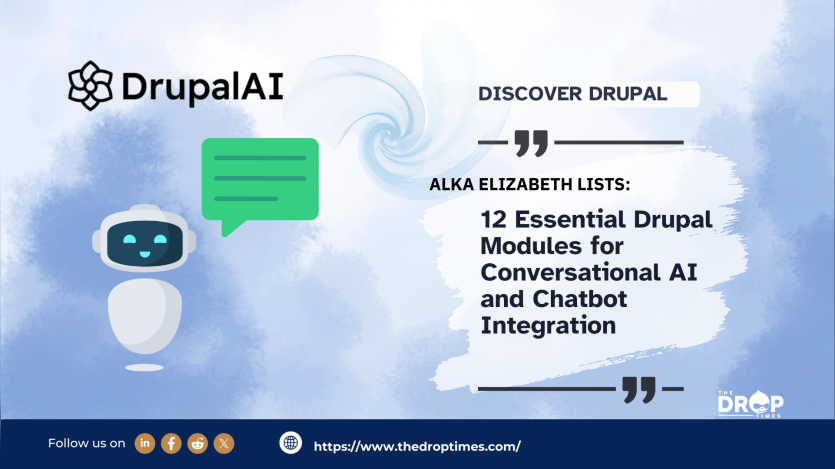
Chatbots are no longer optional. They’ve become essential for delivering fast, intelligent, and scalable user experiences on the web. For Drupal developers, Conversational AI modules offer a direct path to embedding smart assistants into websites with minimal effort. These tools tap into leading AI providers like OpenAI, AWS, and WebLLM to enable everything from real-time chat to context-aware responses.
Curated by The DropTimes under the category Conversational AI & Chatbots, this list features 12 standout Drupal modules that make it easier to build and integrate conversational interfaces. Whether you're looking for multilingual support, offline AI, or deep integration with Drupal nodes, these modules cover a wide range of use cases to help developers create responsive and engaging digital experiences.
Custom AI Chatbot Module for Drupal 9.x, 10.x and 11.x
The AI Chatbot module for Drupal integrates AI capabilities from Open AI, Google Gemini, and Anthropic Claude to provide a customizable chatbot interface for websites. It allows site builders to configure AI prompts, welcome messages, and agent names, ensuring interactions are tailored to the site's content and context. The module features a mobile-friendly chat UI, session persistence, and response caching for enhanced performance. Configuration options include AI API settings and custom data prompts, making it a versatile tool for developers seeking to enhance user engagement through AI-driven conversations.
OpenAI Client
The OpenAI Client module for Drupal integrates the OpenAI API, enabling natural language processing and AI functionalities within Drupal sites. It allows users to configure their OpenAI API token, view available models, and utilize an AI conversation content type for chat interactions. The module also supports image creation via text prompts, requiring images to be converted to Base64 format for compatibility. Developers can leverage the module's service interface to access AI models, perform chat queries, and generate images, enhancing site interactivity with AI-driven features.
Quickchat

The Unofficial Quickchat Integration module for Drupal enables seamless integration with Quickchat, a multilingual AI assistant powered by OpenAI's GPT-3. It facilitates the automation of customer support and other tasks by embedding Quickchat chatbots into Drupal sites. The module includes sub-modules for displaying chatbots and managing knowledge base entries, allowing for enhanced interaction and training of the AI model. Installation requires a Quickchat Scenario ID and API token, and configuration is managed through the Drupal admin interface.
n8n chat

n8n Chat Drupal module integrates n8n chat widget functionality, enabling seamless chat experiences through n8n workflows. It offers easy integration with n8n webhook URLs and flexible placement options, allowing it to function as a global widget or within specific blocks. The module supports responsive design for both desktop and mobile devices and provides customizable appearance options, including light/dark themes and custom CSS. It features automatic session management with unique IDs, persistent conversation history with a 24-hour expiry, and allows users to start new conversations at any time. Additionally, it integrates with Drupal's AI Chatbot module and can share optional user information with n8n workflows. Developed using generative AI tools, the module benefits from rapid development, AI-assisted code review, comprehensive documentation, and adherence to Drupal coding standards and security practices.
AWS Bedrock Chat
The AWS Bedrock Chat Module integrates AWS-powered Generative AI into Drupal 10 and 11, enabling real-time chat interactions through an AJAX-powered interface. It allows site builders to create personalized chat experiences using a knowledge base or agent, configurable via AWS Bedrock. The module supports multilingual sites, offers customizable UI options, and utilizes Anthropic Claude models for enhanced functionality. Configuration includes AWS authentication and model management, with permissions set for secure access. The chat block can be placed via the block layout interface or directly in templates using Twig Tweak.
AI Chatbot Plus
AI Chatbot Plus Drupal 11 module facilitates AI-powered chat popups by integrating with various AI providers through php-chatbot. It offers a customizable user interface, configuration forms, and an AJAX endpoint, making it straightforward to extend and theme. This module provides Drupal developers with a flexible solution for implementing interactive chat features on their sites.
Offline AI
WebLLM AI integrates advanced artificial intelligence capabilities into Drupal sites, enabling browser-based language model execution using WebGPU. Offline AI operates entirely offline, ensuring complete data privacy by eliminating the need for external API keys or cloud services. It supports various WebLLM models and includes features like Retrieval-Augmented Generation for context-aware responses, an interactive chat interface, and AI-powered content generation tools. Ideal for privacy-focused applications, it requires modern browsers with WebGPU support and is compatible with Drupal 9.3+ or 10+.
Civic AI
Civic AI is a Drupal module designed to enhance civic engagement platforms with AI-driven capabilities. It offers intelligent routing, a flexible permission system, and scalable architecture to support public consultation, citizen services, and decision-making workflows. The module facilitates chat-based civic assistants, automated form handling, and AI-informed community surveys, making it suitable for governments, NGOs, and civic tech platforms. Compatible with Drupal versions 9 through 12, it provides configurable settings accessible via the admin interface.
MeetMy.bot Clone
The MeetMy.bot Clone module integrates the MeetMy.bot Clone AI chatbot service into Drupal sites, allowing site administrators to embed interactive chatbot interfaces using Drupal's block system. It supports multiple bot instances with customizable settings, including modal interfaces and preview videos. Designed for responsive and accessible use, the module facilitates customer support, lead generation, and user engagement without complex development. It adheres to Drupal best practices, ensuring compatibility with Drupal's core features and accessibility standards.
Netcall AI Widget
The Netcall AI Widget module enables Drupal sites to integrate the Netcall AI widget seamlessly across all pages. It provides flexibility by allowing overrides on individual pages or specific site sections to display different widget versions. The module requires no additional dependencies and can be installed like any standard contributed Drupal module. Configuration is managed through a dedicated settings page, with permissions adjustable via the Drupal admin interface.
Neuraflow

Neuraflow module integrates AI solutions from Neuraflow GmbH into Drupal, specifically through the neurabot integration. After installation, users can configure their assistant ID and display settings via the admin interface. A valid contract with Neuraflow GmbH is required to obtain the necessary assistant ID for activation.
AI Talk with your node
The AI Talk with your node module enables interactive AI-driven conversations with specific Drupal nodes, focusing on content related to a single topic. Users can navigate to a page and query the AI, which responds based on the node's content. The module supports multiple fields and can parse content attachments, including long documents, by adding instructions and node content to the AI's context window. It is recommended to use an AI model with a large context window to accommodate this feature. Configuration involves adding a block to desired content types, allowing targeted AI interactions. This module differs from similar solutions by limiting its scope to individual nodes rather than the entire site.
 Alka ElizabethMy puns are intended.
Image Attribution Disclaimer: At The Drop Times (TDT), we are committed to properly crediting photographers whose images appear in our content. Many of the images we use come from event organizers, interviewees, or publicly shared galleries under CC BY-SA licenses. However, some images may come from personal collections where metadata is lost, making proper attribution challenging.
Our purpose in using these images is to highlight Drupal, its events, and its contributors—not for commercial gain. If you recognize an image on our platform that is uncredited or incorrectly attributed, we encourage you to reach out to us at #thedroptimes channel on Drupal Slack.
We value the work of visual storytellers and appreciate your help in ensuring fair attribution. Thank you for supporting open-source collaboration!
ASK: Drupal Community Needs Your Support
View all →
Note: The vision of this web portal is to help promote news and stories around the Drupal community and promote and celebrate the people and organizations in the community. We strive to create and distribute our content based on these content policy. If you see any omission/variation on this please reach out to us at #thedroptimes channel on Drupal Slack and we will try to address the issue as best we can.

Related Drupal Initiatives

You may also like