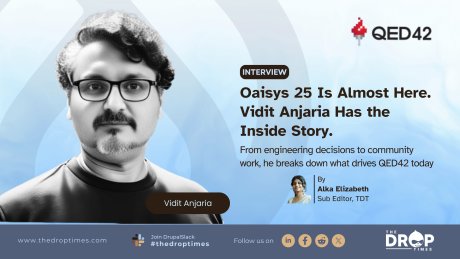




Oaisys 25 Is Almost Here; Vidit Anjaria Has the Inside Story

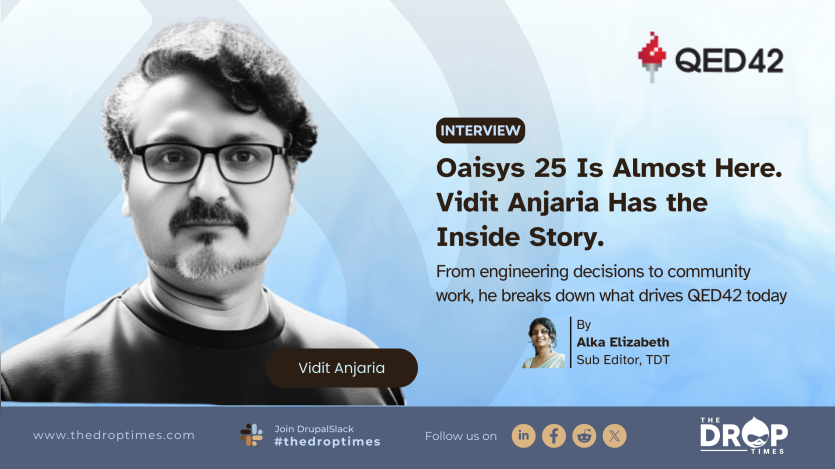
Vidit Anjaria has spent his career moving between engineering roles with the kind of versatility that is rare today. From front-end theming and module development to architecture and team leadership, he has carried the hands-on experience of those early years into his current role as Engineering Manager at QED42, where he leads the Drupal front-end and JavaScript practice. His teams rely on him to bridge product needs with technical clarity, and he has become known for bringing structure to fast-moving, high-expectation projects.
Inside QED42, Vidit Anjaria plays a central role in shaping engineering standards and guiding contributions across Drupal and adjacent ecosystems. His team has worked on initiatives like the Space Design System, supported the growth of Drupal Forge templates, and stayed active in Drupal AI efforts. He also works closely with QED42's business side, helping clients navigate decisions that balance ambition with real-world constraints, something he learned early when he discovered how easily trends can overshadow outcomes.
This conversation with The DropTimes Sub-Editor Alka Elizabeth arrives at a key moment. With Oaisys 25 set to take place this weekend, Vidit offers a first look at what the industry's newest open-source AI practitioners' event aims to spark. Hosted by QED42 in collaboration with FreelyGive, Oaisys brings engineers from across tech into one space for sprints, discussions, and hands-on exploration that goes beyond the usual meetup format. Vidit shares why this event marks a shift, how it opens doors for collaboration across ecosystems, and what it signals about the future QED42 is preparing for as AI, open source, and headless architecture move closer together.
TDT [1]: Your profile notes your background as a CSENT engineering manager with deep experience in Drupal, front-end development, and architecture, so how did you first get introduced to Drupal and what convinced you to stay with it throughout your career?
Vidit Anjaria: I am currently working as an engineering manager, as you rightly said, and I manage the Drupal front-end and JavaScript practice at QED42, a team of 30-plus engineers.
I started out as a front-end engineer. I would say a full-stack engineer who was just starting a career and wanted to try everything. In the initial phase of my career, I worked as a module developer as well as a UI developer, responsible for theming and front-end architecture.
That hands-on background still shapes how I lead today. Yes, I have worked at 2 AM, late at night. I have handled front-end fixes and IE6 bugs, so I understand the pain our front-end developers sometimes go through.
TDT [2]: As an engineering manager at QED42, what does your role involve, and how have your front-end and Drupal architecture experiences shaped the way you work with engineering teams today?
Vidit Anjaria: Yes. My role typically blends the engineering team and the business team, where I need to play different types of roles.
I need to govern delivery and identify capability-building areas for team members. I also need to keep myself updated with the new trends coming up in tech.
I make sure the right people are aligned to the right problems on projects. On the business side, I get involved in pre-sales activities where I interact with clients, understand their needs, suggest the architectures they are looking for, and provide estimates and proposal submissions.
TDT [3]: QED42 has built a strong reputation in the digital experience space and is well known across the Drupal community, so how would you define its core engineering philosophy and how does it shape your approach to client projects?
Vidit Anjaria: At QED42, our philosophy is quite simple. We believe in quality first over quick fixes, and we combine that with an open-source-first mindset.
Since QED42 started, we have always been an open-source-first company. We use open-source technology, and we do not treat the projects, requirements, or products we work on as backlog items. Instead, we take a consultative approach with clients to understand the outcome they want, who their end users are, and how they envision the project or product making a real impact.
I have a good example. A client once came to us with a very lengthy requirement document. Instead of starting to build it as is, we discussed it with them in the initial phase. We realized they were very enthusiastic about their product and ideas, but around 60 percent of the features in the document were assumptions they did not actually need.
That level of collaboration and clarity is what we provide. It helps clients reach enterprise-grade performance and accessibility. We also make sure the projects we deliver are always future-ready in terms of architecture so they can survive the tests of time.
TDT [4]: QED42 has made strong contributions to the broader Drupal and open-source ecosystem, and you also mentioned having real-life examples earlier, so can you share an example where you or your team were involved in work that created real value for your clients or for the Drupal community?
Vidit Anjaria: If you talk about open source, QED42 has an open-source mindset in its DNA. Everyone who joins us comes in with the understanding that open-source contribution is a must for them to do or perform.
And staying committed to that, we are not only heavy contributors in the Drupal ecosystem, but we have also been contributing a good amount to the Next.js and Strapi ecosystems as well.
Apart from that, on the Drupal side specifically, we have been active in Drupal contributions. Nowadays, the Drupal AI initiative is quite trending, and we have done a good amount of contributions there. We provide strong support to the Drupal AI initiative.
We have also been contributing to Drupal Core. Recently, we launched one of our accelerator themes based on the SDC architecture. Its name is Space Design System, and users can definitely try it out.
On the community side, whatever we build, we try to make it accessible. For example, the Drupal Pod templates platform is now available, which lets people try things easily. If I build something and someone new in the community wants to explore it, we provide a ready-made template. They can go to Drupal Pod templates, click the template, spin up a site, and immediately see what has been developed and how to achieve the same output.
We are not stopping there. Keeping open source in mind, we have started contributing to the AI repo as well. And as you rightly said, we have an upcoming event where all practitioners will come together. It will not only be from Drupal or any JS-specific background. It is across tech backgrounds. We will collaborate and have knowledge-sharing sessions there.
For us, contributions and open source are about contributing meaningfully and helping new developers adopt the technology more easily. That keeps their curiosity alive and adds real value to the community.
Whatever contributions we make, we do not consider them charity. These are investments that make tomorrow's projects easier for us and for anyone facing similar problem statements.
TDT [5]: When we talk about client projects and what the company has delivered, we usually focus on the success stories, but were there any technical or architectural decisions that did not go as planned, and is there something your team learned from that? Do you have an example of such an experience?
Vidit Anjaria: I need to think about a mishap. One memorable experience is there, for sure. Everyone has mishaps in their career while working on projects, and we are no different. One experience was when we were very enthusiastic about Headless when it first launched. We started considering Headless everywhere, even on sites that did not need it.
At first, it sounded future-proof because we had an API-first CMS and a composable architecture. We thought we would easily use Headless for those sites. But in practice, it started creating editorial friction. It created SEO challenges. We had to maintain two code repositories, two different deployments, and two caching layers. These were the kinds of tech problems we had to handle at that time.
And in parallel, we were not able to see any real business benefits from it.
I think the client was actually relieved when we recommended going back to Drupal Native after the first demo, within two weeks. They were also seeing it was not going to be fruitful for them. Their exact words were, "Thank God someone finally had the guts to say this."
That taught us that clients hire us for honesty and the transparency we maintain with them. And the lesson was clear: whatever architectural decisions we take should always follow the business outcomes and how it will impact the end users. It should not come out of excitement just because something is trending.
So our mindset shifted from "Headless by default" to choosing the right level of architecture from the beginning.
TDT [6]: Do you think Headless is particularly relevant in 2025, and where does QED42 see the greatest opportunity to make an impact with it?
Vidit Anjaria: Headless is definitely going to be helpful in 2025. And if we talk specifically about 2025, it is going to be the year of AI, open-source AI, and Headless for sure.
But as I said, every problem has its own way of being evaluated. And with the way open-source AI models are becoming mainstream, it is going to be a piece of cake for anyone to build websites. There was a time when we used to think a developer could describe what they want to build in plain English, and someone would generate the component, test it in the background, and provide performance recommendations. Today, that is no longer science fiction.
We are building toward that right now. There are so many tools available in the market that already do this, and the convergence is happening. Open-source AI models mean you do not need a Google-level budget to innovate.
Headless architectures mean your content works everywhere, not just on the web but across channels. And when you combine that with community collaboration, it means you are never solving problems alone.
At QED42, we want to lead from the front on this. Our strong contributions in engineering practices like Drupal, JS, and QA are now extending into AI as well.
TDT [7]: When you're working on a decoupled implementation, what decisions do you find most critical early in the process, and are there any trade-offs or architectural patterns you often revisit across projects?
Vidit Anjaria: I personally feel that when working on a project, especially with Drupal and the Headless ecosystem, the most expensive mistakes happen in the first two weeks.
Based on the experience I mentioned earlier about choosing Headless everywhere, even where it wasn't needed, we learned to ask ourselves certain questions before deciding the approach. Questions like: What type of site is it going to be? Is it content-heavy, or does it need quick user interactions? What kind of authentication layer does it require? How many user roles are needed, and how should access control be managed?
Editorial workflows and SEO strategy are also very crucial. In Headless setups, for example, if an editor creates a page but cannot preview how it will look for end users, it becomes a challenge for them to build pages confidently.
We also ask how many integrations the project needs and whether those integrations actually help the site or the business.
Based on these questions, trade-offs definitely happen. We need to choose between flexibility and complexity, developer productivity and editorial control, and cost versus scalability.
We always try to make sure we are not over-engineering something. Otherwise, it becomes an overkill for the client. A good example is MACH architecture. MACH means microservices, API-first, cloud-native, and headless-related architecture. It works well for enterprise-level platforms, multi-brand ecosystems, and integration-heavy systems. But for simple marketing websites, MACH architecture is definitely an overkill.
So we always choose architecture based on the business needs, not the buzzwords.
TDT [8]: Tools like accelerators and internal frameworks can dramatically change delivery timelines and consistency, so how has QED42 approached building such tools, especially for complex Headless and front-end projects?
Vidit Anjaria: There are multiple tools available in the market today, like Cursor AI, v0.dev, and GitHub Copilot, which really help generate good UI components and documentation. Sometimes they also help with architectural scaffolding.
At QED42, everyone follows certain best practices. We use simple design systems like SDC, and we also have our own design system. It has a simple language so that if we try to generate components using LLM tools, they can easily generate the code, whether it is Next.js-based or Drupal Native-based. Whatever the tech stack is, technology has not remained the main challenge anymore.
Nowadays, a developer should work on real problems instead of spending time setting up the architecture. The basic things we need to kickstart a project can be achieved through the AI tools available in the market. We rely heavily on them, and they have tremendously helped us reach the next level of productivity.
TDT [9]: AI is making its way into everything, from workflows to personalization to development. How is QED42 exploring or integrating AI into its offerings, and what do you see as the most promising practical use cases right now?
Vidit Anjaria: So… can I be honest here?
I personally feel that 90 percent of the AI implementations today are solutions looking for problems. Everything gets wrapped under ChatGPT, and based on that, people assume it is giving the right output. When I started evaluating products and ideas that way, it drove me crazy.
At QED42, we use AI for the stuff that actually matters. One of the first things we automated was accessibility testing, because excluding a set of users is not innovative at all. Our QA team also started generating test cases with AI, because QA engineers should focus on building quality, not writing the same repetitive test cases for every project.
We also took a bold step early on in the AI days and pitched a great idea to one of our clients, which is now quite popular in the tech world: semantic search. The website we were working on belonged to a huge NGO/NPO that provides public consultation for free. They basically had their own "Google ecosystem," where users came to the site with specific problems and needed relevant information. The earlier search system we had implemented felt like a black hole to them. Users would search for something, but the stakeholders felt they were not getting relevant or prompt results.
We introduced semantic search and launched the feature for them. The client was very happy with the outcome.
We did not stop there. We realized this was a market need, so we built our own AI-based product, Aeldris. We questioned why developing a semantic search or RAG application should take hundreds of thousands of dollars just in consulting. Why should semantic search require a data science team? It should not. Now it does not, because the product we built can be a great kickstart for anyone who wants to build semantic search, chatbots, or RAG applications. Whatever use cases they have across those areas, they can generate solutions using a low-code platform that provides ready-to-use code for their websites.
So our philosophy has shifted. If AI does not make someone's day better, then we are doing it wrong. We do not want people to be left behind, so we keep building and keep democratizing the tech space a little more.
The product I was talking about is not 100 percent open source, but it can really be a great kickstart for everyone to look at and try out.
TDT [10]: DrupalCon just wrapped up last week. Are you keeping a close eye on the developments happening, especially around the Drupal Layout Initiative and Drupal Canvas? What do you think about these updates?
Vidit Anjaria: As I mentioned, QED42 follows open source contributions quite regularly, and it is in QED42's DNA. So we keep up with all the DrupalCons.
Even in the last DrupalCon Asia, a good number of our team members attended. We are very well versed in the initiatives as well. I already touched on Drupal Pod templates, where we rolled out large templates for people to use.
Apart from that, our theme, the Space Design System theme, is based on the latest initiatives, like the Single Directory Components approach. The components available inside that theme can be used with the Experience Builder and the Canvas field, which are the current talk of the town in the Drupal world.
We are coping up quite well, and it is a coincidence that our theme's name, Space, aligns a little with the Starshot initiative and the future of Drupal CMS.
TDT [11]: QED42 is a well-known name across Indian Drupal events, from hosting regular Drupal Pune meetups to running monthly online sessions, and with OASIS happening next weekend, how do you think hosting and contributing to these events has impacted the community? What positive changes have you seen from bringing people together to discuss Drupal and open source values?
I personally feel that if we really want to grow our knowledge, then collaboration is the best practice.
Even if I talk about my college days, when I was in college, QED42 was already around, I guess. Back then, I felt that when I studied alone, things were harder. Whenever I studied in collaboration, everything felt easier and the problems became simpler to resolve.
So whatever events we have hosted, and whatever events we are a part of, we personally feel that we are able to solve something that is being discussed there, or it becomes a good learning opportunity for us to get started with.
By keeping that in mind and keeping our curiosity alive, we always make sure to provide a platform where everyone can collaborate, come together, and discuss the interesting things they are working on, and what we can learn or share. That is the core motive behind hosting and being part of all the events happening around.
TDT [12]: Have you seen any positive changes within the group? Are these events attracting new people into the community? Do you see more curiosity about what is happening in the community, even outside the tech space or outside the Drupal community?
Vidit Anjaria: Yes, of course, I have seen the benefits. If I talk about the Drupal Pune community specifically, our CEO, Dipen, started the Drupal Pune community back in 2007. At that time, people from all over India were joining. I think around 20 to 25 members joined the community in the beginning and conducted the meetups.
Since then, in every meetup we have conducted, we have kept dedicated slots for knowledge-sharing sessions. Based on that, we have seen a good amount of capability building happening across team members.
And we have not limited it to developers or active community contributors. In many of the meetups we have organized, we also reached out to multiple colleges so that the young generation entering the tech world would feel motivated and excited. The curiosity stays alive, and they feel encouraged to join the meetup.
At many events, we have seen a good number of students joining from various colleges and tech backgrounds. They appreciated the work the community is doing.
In one of the meetups, there were five or six students who told us how our meetup helped them choose a career in Drupal. They shared how well they are doing after joining our meetup, how they ended up joining a Drupal company, and how the meetup helped them understand the Drupal ecosystem. They learned Drupal from scratch. They had no prior knowledge, and through the meetup and community support they understood everything and joined the company.
This is how the impact has been made across different groups.
TDT [13]: It is important to have new people joining the community to keep it growing. So moving on, it is high time we talk about Oaisys 25, the AI Practitioners Conference hosted by QED42 and featuring FreelyGive. What can you share about the event, and how excited and busy are you right now as it approaches?
Vidit Anjaria: Currently I am quite occupied with the event for sure, and there are many things that need to be managed. Even though we have been hosting Drupal meetups and Drupal Camps in Pune, this is a completely different kind of event. It is an event where we are going to have folks joining us from different corners of the world.
We have two directors, the team lead and the director from FreelyGive in the UK, joining us. We have a couple of people joining from the Bangalore community as well.
This is the first kind of open source AI practitioners event that will bring engineers from different ecosystems together. And our AI practitioners event is not just talks. It is going to have engineers from across tech, and it will definitely not be limited to Next.js, the JS ecosystem, or the Drupal ecosystem.
We are also going to have something called code sprints. It is a common term in the Drupal community, but we will be doing it in a different way for the AI world. Because the future of web development will not be about choosing sides. It will be about identifying the right approach and bringing the best tools together.
Keeping these things in mind, we are expecting the event to be a great success. And through your medium, I would like to invite interested folks to join us for the event happening on the 29th and 30th of November in Pune.
TDT [14]: The event title, OASIS, is interesting. I suppose it is pronounced as Oaisys and also plays on the word itself. How did you come up with the name for the event?
Vidit Anjaria: We were brainstorming around the name of the event. Initially, when we were naming the Drupal Camp and figuring out acronyms, we were not able to fit anything, and then DCP came into the picture. But this time we brainstormed properly, and Oaisys came from the idea of Open Source AI Systems. Based on that, we named it Oaisys.
TDT [15]: As we reach the end of 2025 and look ahead to 2026, there are many changes happening in Drupal. Adoption is improving, updates are rolling out, and people are excited. With all the developments around open source, AI, decoupled architectures, Drupal CMS, Starshot, Drupal Canvas, and more, how do you see all of this coming together, and what role is QED42 aiming to play in shaping what comes next?
Vidit Anjaria: As we look ahead, it is clear that open source, AI, and headless architecture are converging into the new foundation of modern digital experiences.
When we talk about headless architecture today, consuming content is no longer limited to desktop or mobile screens. There are many different screens and channels where content is consumed. In parallel, we are entering a world where AI accelerates development. Open source communities are setting the standards, and CMSs like Drupal and Strapi are becoming composable to deliver across the channels I mentioned.
At QED42, we are committed to shaping the future. We have never called QED42 a Drupal shop or a Drupal company. We always say QED42 is a digital experience company, and we take digital forward. We collaborate, we adopt new technologies, and we make sure we identify the emerging tech and understand how it can be used with Drupal, and what gains it can bring to the team.
Based on that, we build capability-building programs inside the QED42 ecosystem. Similarly, we will continue playing a role in open source and contributing where we can. We make sure that whoever is trying to learn something new will not be left behind.
I can recall one example. When the Drupal AI initiative started, we had already been investing in AI capabilities since mid-2023. Since then, we have had our AI practices working on various problem statements. When we discussed Drupal AI in one of our Drupal meetups, we realized that the pace we had reached was ahead of the community. So we conducted webinars and sessions to bring everyone onto the same page.
As I mentioned, growth and learning happen best in a collaborative way. If you have a different set of people working on one problem or different problems, everyone brings their own point of view. By evaluating the solutions that come to the table, we can make the best possible decisions.
We want to be that organization, and we are working in that direction. I believe the next era belongs to the teams that build openly, take responsibility, and innovate without fear. And I truly believe that together, through collaboration, we can create digital experiences that have never been seen before.
This is what I believe, and this is how QED42 plans to move forward in this space.
 Alka ElizabethMy puns are intended.


ASK: Drupal Community Needs Your Support
View all →

Disclaimer: The information provided about the interviewee has been gathered from publicly available resources. The responsibility for the responses shared in the interview solely rests with the featured individual.
Note: The vision of this web portal is to help promote news and stories around the Drupal community and promote and celebrate the people and organizations in the community. We strive to create and distribute our content based on these content policy. If you see any omission/variation on this please reach out to us at #thedroptimes channel on Drupal Slack and we will try to address the issue as best we can.
Related Organizations

Related People
Related Events


Related Drupal Initiatives

You may also like