



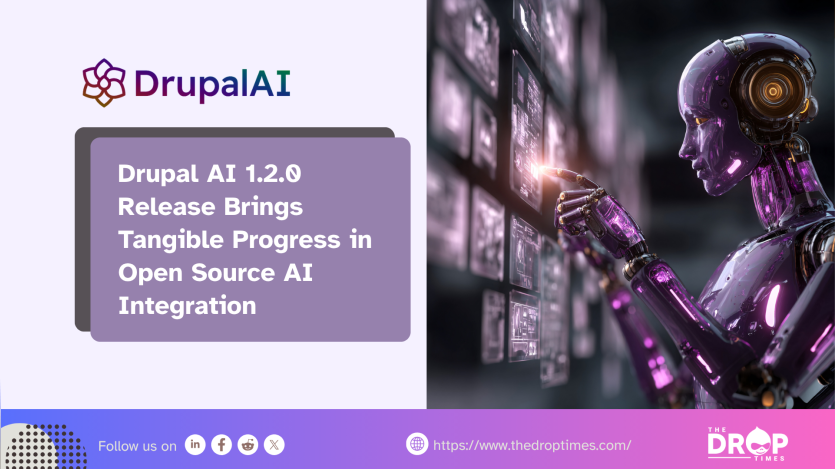
Drupal AI 1.2.0 Release Brings Tangible Progress in Open Source AI Integration

The stable release of Drupal AI 1.2.0 and AI Agents 1.2.0 marks a clear step forward in how artificial intelligence is being integrated into open-source platforms—not just as an abstract concept, but as a set of practical tools for real use cases.
Announced by Paul Johnson in a detailed blog post, this latest update arrives exactly four months after version 1.1.0 and introduces several new features designed to make AI easier to access, more transparent to manage, and better suited for the day-to-day needs of teams working with Drupal.
From editorial enhancements to developer-level controls, the 1.2.0 release doesn’t aim to reinvent how AI fits into Drupal—it focuses on making it work better.
A More Usable AI Experience, Built into Drupal
One of the central changes in this release is the addition of Field Widget Actions, which allow editors to interact with AI directly from within Drupal’s content editing forms. Whether generating a summary, suggesting tags, or proposing a title, AI can now assist at the moment content is being created—without leaving the interface.
For teams working at scale, this small shift could mean faster workflows and fewer repetitive tasks, all while keeping editorial control intact.
At the same time, AI Observability introduces a way to monitor what’s happening under the hood. Built on Drupal’s native logging infrastructure, this new module gives teams visibility into token usage, performance, and potential errors. It’s a foundational step for anyone running AI features in production environments where tracking and accountability matter.
Standardising How Teams Work with AI
Alongside usability and observability, the release focuses on consistency. The new Prompt Library makes it easier to manage and reuse AI prompts across projects. Rather than starting from scratch, developers can ship preconfigured prompts within modules or distributions—promoting best practices and cutting down on redundant work.
Another improvement, the redesigned Toolbar Chatbot, enhances the in-admin experience for users who rely on AI-powered assistance while managing their sites. The update brings a larger, more intuitive interface without breaking compatibility with earlier implementations.
Expanding What’s Possible with AI in Drupal
Beyond UI and workflow updates, Drupal AI 1.2.0 introduces several new capabilities that broaden the range of what AI can do within a Drupal site.
- PDF support has been added to the OpenAI integration, enabling document ingestion for chat-based interfaces.
- Image-to-image editing allows for background removal and visual changes using natural language prompts.
- PHP Fibers support now enables parallel processing of multiple AI tasks, speeding up bulk operations like multi-field translations.
There are also new Automators tailored for accessibility and SEO. These include automatic alt text generation, image filename rewriting, and summary creation for body fields—all powered by AI and configurable by site builders.

And for developers, a new Mocking Library enables local testing of AI responses without consuming tokens or relying on live API calls—a practical addition for teams building and iterating quickly.
Built by Many, for Many
This release wasn’t the work of one person or one team. According to the official release notes, Drupal AI 1.2.0 involved more than 240 issues and over 60 new features, contributed by 127 individuals across 64 organizations.
It’s the most collaborative release in the project’s history, reflecting growing interest not just in using AI with Drupal but in helping shape how that integration evolves.
What This Means Going Forward
For developers, the 1.2.0 release offers stronger infrastructure, better tooling, and clearer observability. For editors, it brings AI closer to where they work, in ways that feel more natural and less disruptive. And for teams managing large sites or building on Drupal as a platform, it shows a continued commitment to making AI integration scalable and responsible.
The update doesn’t promise to solve every challenge with AI—but it does give Drupal users more control over how they adopt and adapt it.
The full release notes and download links are available now. Drupal AI 1.2.0 is stable, ready to use, and actively maintained.


ASK: Drupal Community Needs Your Support
View all →
Disclosure: This content is produced with the assistance of AI.
Note: The vision of this web portal is to help promote news and stories around the Drupal community and promote and celebrate the people and organizations in the community. We strive to create and distribute our content based on these content policy. If you see any omission/variation on this please reach out to us at #thedroptimes channel on Drupal Slack and we will try to address the issue as best we can.

Related Drupal Initiatives

Related People


You may also like