



How Drupal Plans to Beat Commercial CMS Platforms with AI-First Approach


Let's make Drupal the best open-source AI-powered CMS on the planet and secure our future.
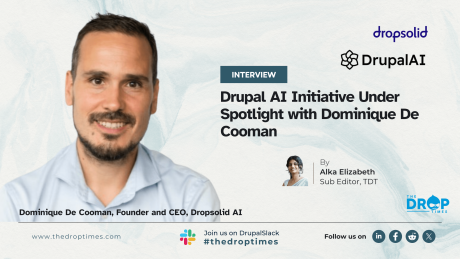
With this rallying cry, Dominique De Cooman, Co-Founder and Co-CEO of Dropsolid AI, a Certified Drupal Diamond Partner, and a board member of the Drupal Association, captures the energy behind a movement that's reshaping how we think about content management in the age of artificial intelligence. His words aren't just a vision statement—they're the battle cry of a community that refuses to be left behind.
The Drupal AI Initiative has just crossed a remarkable threshold: fifteen full-time contributors and over $175,000 in backing, achieved in mere months since its launch. This milestone represents more than funding—it signals a fundamental shift in how the global Drupal community approaches innovation, collaboration, and its competitive future.
In this exclusive interview with Alka Elizabeth, Sub-editor at The DropTimes, Dominique offers an inside look at how this ambitious initiative came together, what's driving the urgency, and how AI is transforming not just Drupal's product roadmap but its entire strategic positioning in the market.
Editor's note: This interview was conducted via Zoom, and responses have been lightly paraphrased for clarity and readability; they may not reflect Dominique De Cooman's exact wording.
TDT [1]: You've been at the forefront of watching digital experience platforms evolve, and now you're helping drive that change from within the Drupal AI Initiative. What moment are we in right now, and what's really at stake?
Dominique De Cooman: We're at an inflection point where AI is fundamentally transforming both Drupal and the entire DXP market. The way websites and digital experiences are built and implemented is changing rapidly.
Let me start with the Drupal AI Initiative because it's central to everything we're discussing. At its core, a digital experience platform still depends on having a robust content management system as its foundation. You can add marketing automation, personalization, and now AI orchestration on top, but if your CMS isn't built to think AI-first, you're building on shaky ground.
The initiative formed in early 2025 at Drupal Dev Days in Leuven. The founding companies came together and met with Dries, who gave us his blessing to move forward. We officially launched on June 9th—which The Drop Times covered—with $120,000 in initial funding. What made this unique was that each founding member committed not just money, but at least one full-time employee and a day per week of leadership time.
We've got Jamie from FreelyGive, Christoph from 1xINTERNET, Baddy and myself as CEOs, plus Kristen Pol from Salsa Digital handling operational management. It's structured as a collaborative "hive mind"—no single boss, but shared decision-making focused on building the fund, operations, and roadmap.
TDT [2]: How are you testing Drupal's AI positioning in the current market, and what kind of response are you getting from customers?
Dominique De Cooman: I took on the business alignment piece early on—essentially becoming the first person to take our Drupal AI narrative directly to customers and test how it resonates in real sales conversations.
Our vision is that Drupal can become the best AI-powered open-source CMS in the world. It's human-in-the-loop, AI-first but not AI-only, and emphasizes AI safety.
We developed this strategy with Dries and then I went out to validate it.
On one side, you have these fully AI-first applications claiming they'll be the "everything app" that takes over all functions. We're approaching it differently. We believe the web and AI are converging, and Drupal is uniquely positioned at that intersection because of its structured content architecture.
Dries wrote about how Drupal accidentally prepared itself to be the best AI-powered CMS through its approach to structured data. That structured foundation allows AI to be applied intelligently to every piece of content, every field, every workflow. We're seeing customers really connect with this vision.
TDT [3]: The initiative just hit fifteen full-time contributors and over $175K in backing. Has the growth trajectory matched your expectations from Leuven to now?
Dominique De Cooman: Honestly, no—it didn't go in a straight line, and we had to adjust along the way, which is completely normal for something moving this fast.
But we're thrilled that within just two months, we more than doubled the initiative. Ten additional sponsors joined, and when you read the quotes from the CEOs putting their best people and money behind this, it's clear nothing like this has happened before in the Drupal community. Fifteen people working on one focused effort with $175,000 in professional funding—that's unprecedented.
We had to make the initiative more inclusive as we grew. We introduced a monetary component and created a partner index that considers agency size and geographic location. From a pipeline of over fifty potential participants, we converted about thirty percent of the leads.
Beyond contributing to open-source code, we're also creating "recipes"—essentially one-click installers for AI functionality. Contributors get early access to these recipes, which gives them a real competitive advantage. They can deliver projects faster with best practices already built in.
I'm optimistic we can reach twenty participants by DrupalCon Vienna, maybe even twenty-five. I'll be there actively fundraising and recruiting. The agencies joining aren't just contributing to the community—they see this as transforming their own businesses from traditional web solution providers to AI-powered web solution providers, with better margins and more valuable client relationships.
TDT [4]: Many commercial DXPs are locking AI features into closed ecosystems. What's the risk if Drupal doesn't define what open-source AI should look like?
Dominique De Cooman: The risk is simple—we become obsolete.
Frameworks that only provide traditional web-building capabilities aren't enough anymore. We need frameworks designed for AI-powered web solutions from the ground up. Drupal CMS needs to ship with everything necessary to be the best open-source, AI-powered CMS in the world.
I see this firsthand with customers. Recently, I was in a meeting with a company already using Drupal, and the boss asked me, "Isn't Drupal getting old?" They'd been hearing from newer systems claiming Drupal had missed various trends.
But when we demonstrated what Drupal could do with AI—how it reduces work for content managers and marketers while giving them more power—the conversation completely shifted. This company struggled with enforcing their tone of voice across their entire content ecosystem. We showed them how Drupal's fine-grained field-level control allows you to apply AI prompts to everything, ensuring content meets exact company standards.
I told them, "Try doing this with a CMS that doesn't have Drupal's granular control." Suddenly, Drupal wasn't "old"—it was essential. The complexity that some saw as a weakness became our greatest strength with AI.
TDT [5]: Let's talk about Dropsolid AI. How is that company developing, and what can you share about its progress?
Dominique De Cooman: We launched a funding round for Dropsolid AI and restructured the business. Now we have Dropsolid Solutions continuing to provide AI-powered Drupal services, while Dropsolid AI focuses on the DXP and enablement platform as a PaaS/SaaS business.
We're gaining interesting customers in the European market—organizations wanting more sovereignty over their platform, as well as those looking for out-of-the-box AI power for existing Drupal sites. Both customer types are valuable to us.
The funding round is progressing well with investors, and we're confident we'll complete this stage to reach our next milestone. We've hired key people, including a new CTO starting in September, though I'll let him announce himself when he's ready.
We're a focused team of fifteen people with strong IP from the Dropsolid platform we've been building for years. Being under the holding company umbrella gives us advantages—certifications and scale to engage larger customers that might be difficult for a smaller company alone.
For agencies looking to transform from web solution providers to AI-powered web solution providers, Dropsolid AI makes a strong partner. We can help them win larger deals they couldn't handle without a complete platform and DXP capabilities powered by our DEEP solution.
TDT [6]: You joined the Drupal Association Board during an exciting time—Drupal CMS evolving, the AI Initiative progressing, Experience Builder launching at Vienna, and a European conference in development. What's your priority as a new board member?
Dominique De Cooman: My focus remains the same as when I first ran for the board—connecting Drupal with other systems and helping the business ecosystem embrace transformation. The AI initiative represents a huge contribution I want to make in this direction.
When Tim Doyle called to invite me to join the board, I hadn't even participated in the elections because I was managing funding rounds for both Dropsolid AI and the Drupal AI Initiative. But the Association wants to help Drupal transform and become future-proof, which means trying new approaches like the initiative and early access programs.
The goal is pushing innovation forward. Even if some experiments fail, we learn from them. That's better than playing it safe while watching our numbers decline. We are the solution we've been waiting for. If we understand that our future is in our hands, we can make it work.
TDT [7]: From your position working in both strategy and community, where do you see the biggest gap between what Drupal is building and what the market actually wants?
Dominique De Cooman: That's an excellent question, and it's time to prove whether our approach is right.
I believe Drupal CMS positions us well to move down-market and then expand our reach. We need Experience Builder as a powerful tool for building beautiful pages, even as AI generates the first versions. The polishing still requires human touch.
Experience Builder, AI capabilities, and Drupal CMS are all converging. Another underestimated initiative is the template store, which could open up significant economic activity around Drupal while providing more out-of-the-box functionality. Our early access features in the AI Initiative work similarly—building recipes from open-source code for one-click installations.
I was reflecting on Thomas Aquinas's definition of beauty: having integrity, harmony, and clarity. It made me think of Drupal. Integrity means completeness—having all necessary features from core to modules to front-end. Harmony means balance between core and contrib, framework and product, human and AI. Clarity means users immediately understand and can operate the system.
We're getting close. Imagine Drupal shipping with a conversational interface for page building, finishing with Experience Builder, applying templates through recipes, installing AI features the same way, and maintaining automatic updates—whether on Dropsolid's platform or others. That's immensely useful, easy to maintain, and cost-effective.
With a few more development cycles—Vienna, Chicago, and beyond—we can get there if the community maintains this level of alignment.
TDT [8]: There's significant skepticism about AI, particularly around workforce impacts and ROI on AI investments. How should organizations balance automation with human control?
Dominique De Cooman: It comes down to accountability, responsibility, and liability. If your system causes damage, you're responsible for the consequences. Every organization needs to determine how much control they're comfortable giving to AI.
There's the benefit of saving time versus the risk of unintended actions. I'm realistic about workforce impacts—AI will transform jobs, and the transition may be bumpy. Some positions focused on repetitive tasks will likely be replaced, but anyone creating real value will adapt and use AI to execute their work more effectively.
This isn't fundamentally different from what happened when digital displaced print twenty years ago. The valuable professionals understood their purpose, their audience, and how to communicate value—they became web designers and digital strategists.
The same applies to AI. You still need to ask: What am I creating? Who is it for? What value does it provide? How do I collaborate with others to achieve these goals? Investing in those strategic and communication skills is critical now.
Dominique De Cooman (closing): If anyone reading this works at a Drupal agency that isn't part of the Drupal AI Initiative yet, please reach out. Fifteen other CEOs have already joined because they see the opportunity. Talk to your leadership and have them contact me. Let's make Drupal the best open-source AI-powered CMS on the planet and secure our future.
 Alka ElizabethMy puns are intended.


ASK: Drupal Community Needs Your Support
View all →
Disclaimer: The information provided about the interviewee has been gathered from publicly available resources. The responsibility for the responses shared in the interview solely rests with the featured individual.
Note: The vision of this web portal is to help promote news and stories around the Drupal community and promote and celebrate the people and organizations in the community. We strive to create and distribute our content based on these content policy. If you see any omission/variation on this please reach out to us at #thedroptimes channel on Drupal Slack and we will try to address the issue as best we can.
Related Organizations