



Is MySQL Still Right for Drupal? Andrés Torres Russo Urges a Rethink

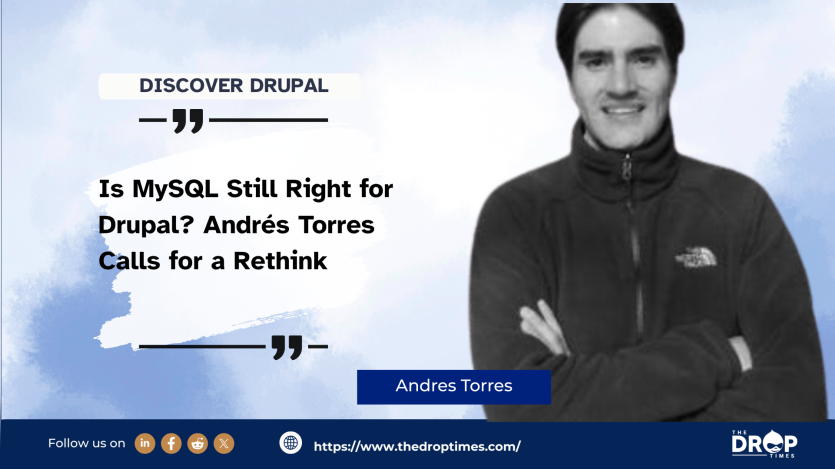
Drupal developer Andrés Torres Russo has questioned whether MySQL should remain the default database in Drupal’s LAMP stack, citing concerns about long-term stability, open-source governance, and the widening gap between the community and proprietary editions. In a LinkedIn post, he argued that backend decisions should reflect Drupal’s commitment to open-source values rather than rely on historical defaults.
Torres framed the issue as a structural one rather than a performance comparison, stating that the community should begin “measuring a transition” as foundational technologies evolve. He pointed to uncertainty around Oracle’s stewardship of MySQL and emphasised the importance of aligning with platforms that prioritise transparent, community-driven development.
Without endorsing a single replacement, Torres contrasted MariaDB and PostgreSQL as viable alternatives for different architectural needs. He noted that MariaDB offers continuity for existing stacks, while PostgreSQL is increasingly adopted across open-source projects for its robustness and extensibility. He described the choice as “not a competition,” but a strategic decision shaped by long-term infrastructure goals.
MySQL’s broad compatibility, ACID compliance, and tooling support have made it a foundational piece of many web applications, including Drupal. But concerns over Oracle’s governance and the emergence of stronger open-source alternatives have prompted a reevaluation. MariaDB, created in response to these concerns, retains MySQL compatibility while remaining 100% open-source. PostgreSQL, meanwhile, is gaining traction for data-intensive use cases requiring high concurrency and schema flexibility.
Torres’ call reflects broader industry trends. As projects grow in complexity and integrate technologies like AI, backend choices increasingly hinge on sustainability, governance, and adaptability—not just legacy comfort. His message was not about immediate migration, but about preparing Drupal’s infrastructure for the next decade.
The post triggered community discussion. Eric Aguayo, an AI engineer, observed that PostgreSQL tends to outperform in write-heavy, high-concurrency environments, while MySQL traditionally excels in read-heavy scenarios. Christopher McIntosh raised concerns about PostgreSQL compatibility within Drupal’s contributed module ecosystem, a reminder that official support does not always guarantee optimal real-world outcomes.
Other developers, such as Rajib Chandra Paul, pointed to successful PostgreSQL use in Python/Django projects, underscoring its maturity and broader relevance across the open-source landscape.
The discussion highlights a broader question facing open-source projects: when governance, ecosystem health, and sustainability begin to outweigh familiarity, how should defaults evolve? The conversation about MySQL’s place in the open-source ecosystem is ongoing. Drupal developers and site builders are encouraged to share their experiences with database migrations and strategic infrastructure decisions as the community considers a future-proof path forward.


ASK: Drupal Community Needs Your Support
View all →
Note: The vision of this web portal is to help promote news and stories around the Drupal community and promote and celebrate the people and organizations in the community. We strive to create and distribute our content based on these content policy. If you see any omission/variation on this please reach out to us at #thedroptimes channel on Drupal Slack and we will try to address the issue as best we can.

Related People


You may also like