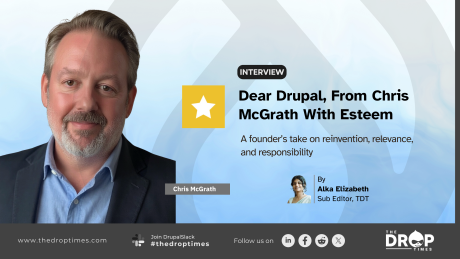




Dear Drupal, From Chris McGrath With Esteem


When Christopher McGrath first explored Drupal in 2010, he wasn't trying to build a company. He was a stay-at-home parent with a background in tech, looking to start a blog. That project opened the door to a much bigger journey. It led to the creation of Celebrate Drupal, the launch of DrupalContractors.com, and later the evolution of Esteemed, a platform now focused on rethinking how companies hire, scale, and build in a rapidly changing digital world.
In this interview, conducted by Alka Elizabeth for The DropTimes, Chris reflects on more than three decades in enterprise technology. He talks through the highs and lows of Drupal's trajectory, the shift to headless and AI-driven platforms, and the growing demand for developers who can work alongside automated systems. He also explains why Esteemed has invested heavily in coding agents, and what that means for the future of engineering teams.
Chris speaks with candour about the gaps between executive vision and technical reality, the fear and resistance developers feel around automation, and the perception problems Drupal continues to face. Whether you're in product, engineering, or open source leadership, his insights offer a grounded look at where the industry is heading and what it takes to keep up.
TDT [1]: You have over 30 years of experience in enterprise CMS and have worked with Drupal, Salesforce, AEM, Sitecore, and others. Focusing on Drupal, how did you first get involved with it, and what makes it stand out compared to other enterprise CMS platforms?
Chris McGrath: It was kind of a funny story. I was a stay-at-home dad at the time, and I find it difficult to stay idle in business. Although my wife and I decided it was best for me to stay home, I still wanted something else to do. I had taken a break from technology and studied sustainability, looking to create something I was passionate about. I wanted to create a blog.
I have a lot of friends from my background in technology. One of them, Thomas Scola, is part of the Drupal community and the founder of BlueFly. He had worked at an agency using Joomla, Drupal, and WordPress. He said I could use any of them, but he thought Drupal was the best. This was around 2010.
I tried setting up WordPress and Joomla. Joomla took about 15 minutes before I shut it down. WordPress didn't really resonate with me, even though in hindsight it might have been a good solution for what I wanted to do. But Drupal really clicked. At first, I remember wondering why it was so minimal, like why there wasn't even an image field. But then I started asking questions, and people explained it was that way on purpose. I thought, okay, but come on, people will want an image field in their content type, for example.
That blog eventually turned into a user-generated content magazine using the Feeds module. I had 40 or 50 writers, similar to what you're doing, and they had their own ads and other features. That wouldn't have been possible with another solution. That's how I got bitten by the Drupal bug. I went on to grow that business and my expertise in Drupal. That coincided with the rise of Drupal 7. With my other tech background, I became one of the more experienced people in the room at that time, especially in this area. That was the beginning of my Drupal agency journey, and I formed Celebrate Drupal shortly after, around 2011 or 2012.
TDT [2]: You co-founded and led Celebrate Drupal for nearly 10 years. Then you stepped back, and Esteemed came into formation, if I understand correctly. How was the transition from Celebrate Drupal to Esteemed?
Chris McGrath: Well, I think it's no secret that Drupal has gone through some changes. The shift from Drupal 7 to Drupal 8 was a major shake-up for customers. At that time, there was a noticeable contraction of certain enterprise clients, which scared a lot of people in the community. These were delivery customers who had already just upgraded, and then they were hearing they might have to do it again.
There was also a rise in headless implementations, and technologies like React, Angular, and other JavaScript tools were being incorporated. More sophisticated back-end integrations were becoming common. As a firm, we were already being introduced to a hub and spoke model of different technologies.
Staffing had always been something we relied on to serve larger agencies, like Phase2 or others with bigger contracts. They might come to us with a project or ask for a specific role, effectively borrowing an employee. That became a steady source of revenue, and I noticed we were good at it. We were helping eliminate friction in the hiring process and acting as a validated tech lead to choose appropriate talent, people we would stake our reputation on.
That went on for a while, and I felt it was time to expand the brand. There were discussions within the Drupal community, mostly with the Drupal Association, and it seemed like we would benefit from changing the name, taking the product out of the brand, and doubling down on the dynamic talent model.
I had already founded drupalcontractors.com at the time, which was part of Celebrate Drupal. It was kind of like Upwork for Drupal. There were several hundred developers available for hire, which was a pretty big community at that time. In fact, it was larger than the practice at Accenture, where I was working.
It was something to be proud of. We had a good model. Compared to Upwork, it wasn't massive, but the people on it had a high degree of credibility and were known in the community as trusted. That made hiring easier and eliminated the risk of impostors or other complications.
It was a difficult choice, but I felt excited about it, and it has worked out well. It was hard to leave behind 10 years of history.
The brand Esteemed felt like a great fit. I was lucky to find that name and connect it with people, talent, and the broader career journey. The name, meaning trust, was important to me. I threw myself into it. This was right at the start of the pandemic, which added an extra layer of complexity.
It turned out to be a good move. It took about a year to sort out things like ownership of Drupal Contractors, which brand we were leading with, and how to transition everything to the new platform. That platform is now called Esteemed Colleagues, which Drupal Contractors has merged into.
TDT [3]: Esteemed started as a Drupal contractor network and has now evolved into a full AI-driven HSCM platform. Does that feel like a natural progression to you?
Chris McGrath: Yes, I think so. There was a phase in between, the SaaS revolution, that really influenced that evolution. As an agency with a dynamic talent model, we didn't have recurring revenue. We didn't have subscriptions. Clients in the US were generally hesitant toward models like monthly billing for talent. It wasn't common, outside of select categories.
We had already been doing projects and contracting work, and we had the capability to build software. We were one of the few agencies I've seen that managed to build a product while continuing to deliver client work and stay operational. So, we took that experience, as tough as it was financially and operationally, and decided to rebuild the platform. At the time, Drupal Contractors was still in Drupal 7, and that needed to change.
Users were demanding more modern, JavaScript-driven front ends. Without that, you couldn't really compete. So we began rethinking the entire platform as an employee experience platform or a talent marketplace. We were already paying off-the-shelf providers for features like applicant tracking, and I didn't like it - not the pricing, not the experience. I knew we could rebuild a lot of that in Drupal ourselves.
TDT [4]: What role did AI play in the transformation of the platform?
Chris McGrath: As we rebuilt the platform, we saw opportunities to integrate AI. Machine learning and AI had already been evolving over the past nine years, but things really shifted with the launch of ChatGPT. Suddenly, it became clear how much friction AI could remove from the hiring process.
Take something as simple as writing a job description. You'd be surprised how often that holds up an entire hire. It can go through three or four people, stall out, get put on a shelf. Being able to generate it instantly from a job title was a big shift, and we added that into the platform right away.
We also noticed new players offering vector search for resumes. At first, it seems like no big deal, maybe just a more advanced keyword search. But under the hood, it processes over a thousand data points on a single resume. And if you layer in public data like LinkedIn, GitHub, or Stack Overflow, you get a richer candidate profile that dramatically speeds up hiring. That's what we're now building into the customer-facing product, Esteemed Talent, which integrates with our applicant tracking system. It's a sophisticated ATS and CRM built in Drupal.
TDT [5]: Was there a turning point where you realized AI agents and automation would be central to the future of work?
Chris McGrath: Definitely. I saw a bigger trend unfolding. People like Jamie Abrahams were leading the Drupal AI initiative. That wasn't my background, or his originally, from what I understand, but he jumped into it and started building functionality directly into Drupal.
I was already working in React, TypeScript, and Node, and I started thinking about agents. It was clear this would become a form of talent in the very near future. I knew that as someone in a leadership role, especially in a company trusted to deliver talent, I had to understand it thoroughly. So I dove in. I started working with people like Jay Callicott, who was innovating in this space, and we began developing a family of agents using tools like Claude Code.
The early challenges were real. Sessions would reset. There was no persistent memory, which is not acceptable for enterprise-grade development. But once we built the right infrastructure, it opened the door to plug in more advanced roles. Engineering, for example, is one of the most sophisticated areas for agent capabilities. It really hooked me. It was very interesting to see this swarm of innovation happening around agents.
People are creating different large language models for specific use cases like finance. That really interested me. At the last DrupalCon in Atlanta, Dries used Legos as an analogy, and it made me laugh. A lot of us probably had that experience as kids. I don't build with Legos anymore, but we've invested thousands into them for my kids. That kind of thinking, putting pieces together, stuck with me.
Soon, we'll release a product called Esteemed Agents. It can be paired with human teams or used independently. Some companies are charging hundreds or thousands of dollars a month for similar tools. Ours can create major efficiency, sometimes improving productivity by 40 to 50 percent.
As Ryan put it recently on LinkedIn, this isn't about replacing your workforce. It's about boosting output. That appeals to leaders of all sizes, whether you're running a two-person shop or a 10,000-employee company. It's a deep subject, a long journey, and a multifaceted evolution. But this is what brought us to where we are today.
TDT [6]: You're at the intersection of HR tech, digital platforms, products, and strategies. What are the most outdated assumptions companies still make about hiring or workforce management?
Chris McGrath: Well, I think that when it comes to outdated assumptions, there's always a hesitancy to spend money to prepare for the future. That must be human nature. I live very closely by the 80/20 rule, or even the 90/10 rule, Pareto's Principle. I know a lot of technical and business folks who do as well. It is definitely the 10 or 20 percent who are going to say, "That thing we have doesn't really work that well, let's build something better." Either they have the capability to do that, a vendor has sold them on something, or they'll design it themselves and hire someone to execute their vision.
In my experience, and yes, I can barely believe it's been 30 years, you see all types. I think one major assumption out there is the old adage, "If it's not broke, don't fix it." As a result, a lot of larger companies we work with, including staffing firms and large consultancies, still don't deliver their services through a platform. Many are still managing things by email, out of their bookkeeping system, or using spreadsheets to organize information. It's extremely inefficient, regardless of what AI tools like Claude can now do with spreadsheets.
We see a wide spectrum, from people who are hesitant to make any change at all, to those embedded in outdated systems. They may have large datasets locked into off-the-shelf products. Their teams are familiar with these tools. It's the same pattern that Drupal followed when unseating incumbents like Microsoft. For example, people were using SharePoint as a CMS simply because they trusted Microsoft, even though SharePoint wasn't really built for that purpose.
So there is a trickle effect when it comes to change. Some organizations are forward-thinking, but the majority are still focused on maintaining the status quo. They aim to fulfill their core mission without necessarily focusing on modernization or increasing efficiency. It takes a leader or a strong internal group to say, "This is what we're going to do to stay competitive." That means making the effort to try new approaches, understand new technologies, and see how they fit into the business.
Ultimately, I don't think it comes down to a handful of specific outdated assumptions. It's more about a widespread mindset. Whether it's government or large enterprises, there are always innovative people, and those who resist innovation.
TDT [7]: You've built products like Esteemed Talent, HCM, and STM. Now there's Esteemed Agents, which helps fill the frontend and governance gap left by tools like Claude Code. I recently read a post of yours where you talked about developments within the agentic model. Could you give us a brief picture of what Esteemed Agents is all about, and what's happening in that space?
Chris McGrath: Sure. I talked about it a little earlier. Esteemed Agents is an adjacent platform to our Esteemed Talent product, which focuses on hiring, onboarding, interview scheduling, and similar functions.
I noticed on platforms like Zapier that "Agents" is now a visible category in the UI. That gave me a useful analogy. Esteemed Agents will be similar, where customers can log into a platform and access a collection of agents. We're starting with Claude Code as one of the popular coding tools that can plug into Esteemed Agents and provide enhancements like persistent memory.
Claude, by default, forgets everything between sessions. So within our platform, we've added what are known as reflections, which allow persistent memory. In addition to that, we've built an entire engineering team of agents, covering JavaScript, PHP, artificial intelligence, DevOps, quality assurance, and visual design. These agents connect to an MCP model context protocol.
An MCP, in simple terms, allows an AI agent or framework to interact with a specific environment. For example, there might be an Outlook 365 MCP or a Figma MCP. Think of it like an API server built specifically for AI.
I've been personally leading this project using Claude Code. Part of that was to understand what was real versus what was hype. There is a lot of hype, although it is a viable experimental engineering tool. I saw an ad for Claude Code that said "idea to v1," and while that's technically true, it's not as seamless as it sounds. You still have to translate your idea into code, and the process can be laborious, similar to working with people.
That said, it comes at a significantly reduced cost. Tools like Claude Code can plug into Esteemed Agents, and the platform also has its own command-line interface. One of its key strengths is that it supports multiple models. It works with Grok, Mistral, OpenAI and its various versions, Claude, Gemini, and others. Users can assign specific models to specific agents depending on the use case.
For example, a CTO agent might need GPT-4 Turbo, while a DevOps agent could use ChatGPT Mini, which is more cost-effective. That flexibility matters. Once I had the tooling working, like the Figma MCP for the visual designer, I saw a large gap. These coding agents had no capability on the frontend. They could build backend systems, but they couldn't see or test what they were doing.
Tools like Claude Code and Cursor just wrote code. You had to test it manually in a browser. That disconnect didn't sit right with me, especially knowing the maturity of tools like Playwright that support automated frontend testing. So we integrated Playwright. Our agents can now run browser-based tests, log into authenticated environments, and perform testing. The results are fed back into the language model, which can provide suggestions or fixes. It closely mirrors how a human would work.
We also integrated a Kanban board into the system, similar to Trello, to manage project flow. From there, I began building departments typically found in a medium-sized business-marketing, finance, product, R&D, legal, and so on. It's been rewarding to plug in different models, as well as small language models that act as domain-specific knowledge sources.
For example, BloombergGPT for finance or highly specialized models from Hugging Face. This allows us to create agents with deep knowledge in specific areas. I've heard of work being done by Brock to train agents to a PhD-level capability. While I haven't seen it directly, the idea resonates with what we're building.
The goal is to offer these agents alongside human teams, or in cases where full automation is desired, provide a purely agentic solution. These can be deployed with Esteemed Talent and also serve as a recurring revenue stream for the company.
TDT [8]: As both a product builder and someone placing talent, I'd like to know, with all the advanced agent tools being developed, what are companies looking for in developers today and in the next few years? What new demands will developers face from employers?
Chris McGrath: I think it's similar to what developers have always faced, only now they have a few new tools in their toolbox. Specifically, coding agents.
I've seen some job application flows recently that include questions like, "How much of your code was delivered by a coding agent in the last 30 days?" or "How many pull requests did you submit with your coding assistant?" It's not always clear whether companies ask that because they value it or want to avoid it. But it's clear the industry is investing in full AI frameworks, and many businesses are expecting developers to use these tools.
What developers are facing now is something I personally had to deal with. I needed to understand exactly what these tools could do so that I wasn't the leader saying, "Why isn't this done yet? I thought this could all be done with a prompt." I went into it with that expectation at first, even with some of our vendors. I thought using AI tools would result in a 10x or even 20x increase in productivity.
Naturally, that didn't play out exactly as expected. Some of the deeper engineers were slower to adopt these tools. Leadership, on the other hand, was often ready to push forward and say, "Use it, or we'll find someone else." I've seen posts on LinkedIn with that exact tone.
That pressure is real. Developers are going to face increasing demands from leadership, who expect these tools speed everything up. Just like always, there will be a disconnect between what expected and it actually takes in time money build something properly. The difference now that technical leaders also under understand apply effectively.
At the same time, the workforce has been affected by layoffs and budget cuts. There was a period when some companies believed they could replace developers with coding agents. Now they are realizing that those agents are not able to do everything on their own, and many of those developers need to be rehired.
Alongside that, there is the ongoing problem of fraud and impersonation in hiring. This has been around for at least a decade. People present fake profiles, pose as someone else, or use deceptive tactics to get through interviews. A colleague in the staffing industry shared that up to 30 percent of IT profiles may be fake. That is a huge number.
I recently saw a case where a truly talented developer was put through an intense interview process and was rejected, even though many in the industry know that the company would be lucky to have him. The process failed him, likely out of fear and a desire to avoid fraud. Dishonesty in the system muddies the water for everyone.
One last thing I'll add is the fear I see in parts of the development community toward adopting coding agents. It reminds me of when Drupal was rising. At that time, it was a modular framework, and some developers resisted it. They wanted to write all their own code from scratch.
I remember being on jobs where someone would say, "I built this myself," and I'd be thinking, "Okay, but I could have had that done in 15 minutes with a reusable module." Over time, that resistance faded. Modular systems became the standard. That same pattern is happening now with AI.
There is no question in my mind that this shift will continue. Prominent founders are already saying that those who don't adopt AI tools quickly will be left behind. I agree with that completely.
TDT [9]: Quite recently, Blake Newman wrote that the US Drupal market has hit an all-time low. Drupal developers are struggling to find jobs, many have been laid off, and there's a very low intake of young developers into Drupal. You also shared the IXP initiative on LinkedIn. As someone involved in this industry, how do you think more contributors and end developers can be brought into Drupal? What should the Drupal community as a whole be doing to address this?
Chris McGrath: It is a difficult problem. There's no mistaking the fact that Drupal's popularity has declined. First among engineers, and then, as a result, among leadership. And leadership controls the budget.
There are many reasons for this drop in popularity. From a technical perspective, Drupal has been seen as rigid. Upgrades are difficult and frequent, and they come with high costs. Then there's simple innovation. This is the IT space. Innovation is constant. People are always engineering and moving forward.
Unfortunately, even though the Drupal core maintainer team is well-meaning, solid, and sophisticated, I think Drupal as a project lacked perspective in one critical area. It didn't treat itself like a product. That's changing now, because it has to!
But historically, Drupal didn't approach itself the way a company like Adobe does. Adobe is product-focused. Everything is designed around how their suite is experienced by customers, how it looks, how it fits into workflows. That wasn't the mindset in Drupal's evolution, and we felt that.
That kind of thinking directly affects the workforce. When the product loses ground, the work supporting it, upgrades, feature development, adoption dries up. And Drupal, from a cost perspective, ends up being most appropriate for a relatively small group. That often includes governments, universities, and nonprofits.
The challenge there is that these types of organizations rely on external funding. Endowments, donations, or taxes fund their budgets. So they aren't going to be the biggest consumers of digital transformation services, which is where Drupal fits best.
Engineers figured this out a while ago. Many shifted away years ago. Still, it's not easy. I was recently in conversation with folks in the community, including people like Jamie Abrahams, who's pushing the AI and innovation thread forward. And it's true. Drupal remains a workhorse for storing structured data. It's reliable, powerful, and proven.
If you pair that backend strength with a modern frontend and AI layers, Drupal becomes very viable again. But the reputation damage has been real. It's seen as rigid, complex, and difficult to use. That perception needs to be rebuilt, and that's part of the ongoing challenge.
TDT [10]: With the recent launch of Drupal CMS, do you think Drupal is moving in a direction that is less rigid, where people can adapt more easily? Do you see this as a good direction?
Chris McGrath: I think Dries is a gifted leader. There is no question about that, and he has an enormous number of passionate and talented people around him to help forward that vision. We have already seen what they have been able to do in a short period of time.
I don't want to sound negative, but many people feel this is something that could have been done sooner. When WordPress shifted focus to ease of use, Drupal continued in a different direction.
For years I would go to roundtable dinners where half the table argued that "easy" was no good, that Drupal needed to stay engineering-focused, complex, and enterprise-oriented. The result was that Drupal ended up being left behind. Because in reality, people do want easy, even engineers, since they are also responding to business leaders.
The Drupal CMS project looks good. Automatic Updates, the Experience Builder we saw at DrupalCon Atlanta, and other features are exactly what it has to become. Without those changes, its obsolescence would accelerate rapidly. I am excited to see those evolutions. I think they will help customers already using Drupal and also make it more appealing for simpler, content-facing projects, even though Drupal itself can handle very sophisticated applications.
That said, I don't see Drupal CMS as a magic bullet that will reverse the decline in developer opportunities. The point of the initiative is to make it friendlier and easier to use. On top of that, Acquia is automating many things, offering services where updates and management become simple if you just pay them. This is the reality of the market. Things are competitive, always changing, always in flux. The Drupal Association and Dries are doing everything they can to infuse new life and perspective into the product's competitive positioning.
We saw the Stack Overflow report that listed Drupal at about 2.5% adoption across the Internet. That figure has not changed in years. I commented on LinkedIn that this consistency actually says something important about Drupal's customer base. It is a faithful community, even though of course we would have loved to see that number double or more.
As I often say, PHP still powers the majority of the Internet. Last I checked, it was 76 per cent, and I believe it has grown since then. So Drupal remains a very viable tool. A developer friend who leads the Seattle Drupal community once asked me, "I don't understand why it's considered bad." I told him I don't either. Sometimes people simply want something new. In advertising, "new" is the most powerful word.
So I think it is great that the community is working on this project. There is momentum behind it, and I look forward to seeing how it impacts Drupal's future and its community.
TDT [11]: Keeping aside technology, Drupal, and AI, I'd like to ask one final question. What interests you personally outside of product development and Drupal? If you feel burned out, where do you go, or what do you do?
Chris McGrath: Oh, boy. I'm fortunate to live in the woods, near the water, in the Northwest of the United States, in Washington State, which is known for its immense beauty. I chose to live here very intentionally. I don't travel much, mostly only for Drupal events, which may sound sad, but it is true. And I don't get to as many of those events as I wish I could.
Other than that, I enjoy being in nature. We have a garden, and I enjoy doing the exact opposite of what I do professionally. This is a place that will always have projects for generations to come in my family, and I'm happy about that. It excites me a lot.
Beyond that, I think entrepreneurialism in general, beyond technology, interests me. I am very interested in sustainability. As I mentioned earlier, I studied environmental sustainability for a couple of years, and that is something I still care deeply about. It connects to AI in some ways, but it also ties directly to energy production and consumption. I am fascinated by clean energy and how supplemental heat and other forms of energy can be repurposed.
We have a strong clean energy mindset here in the Northwest, which is one of the biggest energy-producing regions in the country. I find it exciting to explore those ideas, talk with entrepreneurs working in that space, and support them in advancing their goals.
TDT [12]: Anything more to share with our readers?
Chris McGrath: This is the first time I've been directly interviewed by The [Drop] Times. You did another piece on me before, but I wasn't as involved, and I appreciated that. I've known Anu [Anoop John] for a long time, and I applaud everything you are doing. I was really surprised when he told me that it was all volunteer. That was inspiring.
That is one of the reasons I have been a longtime member and supporter of the Drupal community. I appreciate people who are willing to come together and do things that need to be done, even if there isn't a paycheck at the end of it. I think that is exciting, and I applaud your efforts.
 Alka ElizabethMy puns are intended.


ASK: Drupal Community Needs Your Support
View all →

Disclaimer: The information provided about the interviewee has been gathered from publicly available resources. The responsibility for the responses shared in the interview solely rests with the featured individual.
Note: The vision of this web portal is to help promote news and stories around the Drupal community and promote and celebrate the people and organizations in the community. We strive to create and distribute our content based on these content policy. If you see any omission/variation on this please reach out to us at #thedroptimes channel on Drupal Slack and we will try to address the issue as best we can.
Related Organizations