



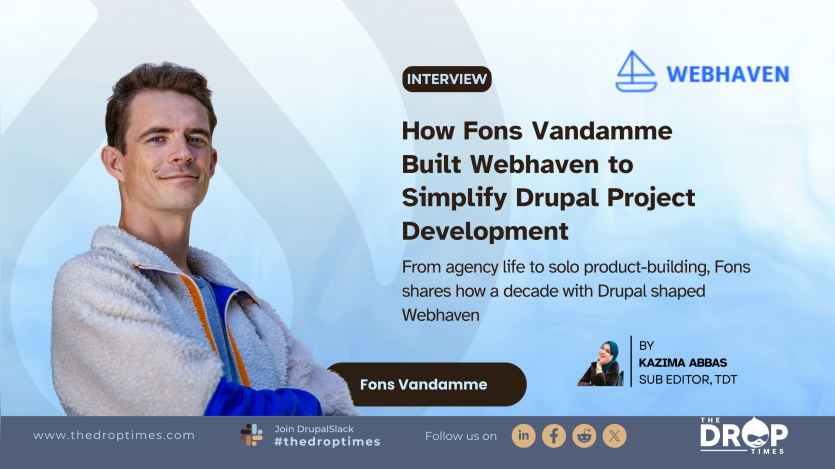
How Fons Vandamme Built Webhaven to Simplify Drupal Project Development

Fons Vandamme has been building with Drupal since 2009. In a tech world obsessed with the next big thing, that kind of commitment raises questions. Is it just loyalty? Habit? Or is Drupal still holding its ground? Fons has asked himself those same questions over the years. Each time, he steps back, tests other tools, and comes to the same conclusion. Drupal still fits.
"I owe a great deal to Drupal and the community around it. I've always been on the lookout for other technologies but Drupal has always felt like the right fit for me up until this day."
Fons spent over a decade helping grow the Belgian agency EntityOne, wearing every hat from developer to strategist to business builder. That mix of roles shaped how he looks at tech today-not just what works, but what lasts. Now, he's channelling everything he's learned into his first solo product: Webhaven. It's a pre-built foundation for Drupal projects, complete with smart defaults, must-have modules, and a clean, extendable design. Whether you're just getting started with Drupal, have years of experience, or you're building for clients as an agency, Webhaven cuts out the repetitive setup and gives you the space to focus on what matters most-building features, creating content, and delivering results.
This isn't just a tool. It's a shift. With Webhaven, Fons wants to simplify the developer experience, speed up delivery, and make Drupal more accessible without watering it down. He's also working on the Webhaven Academy, a learning space filled with practical video content that speaks to learners, challenges experts, and helps agencies stay sharp and on budget. The goal is simple: better Drupal projects, less friction, more freedom.
Kazima Abbas, Sub Editor at The Drop Times, connected with Fons to get his thoughts on community, curiosity, and why Drupal still feels like home.
TDT[1]: You’ve been building with Drupal since 2009. What has kept you locked in for over a decade, especially in a tech world that constantly shifts toward the next new thing?
Fons Vandamme: When I think about it, I guess I really came for the code and stayed for the community.
I’ve met a lot of insanely talented and interesting people along the way, worked on challenging projects and learned a lot since 2009. Drupal has given me so much to be grateful for; I owe a great deal to Drupal and the community around it. I’ve always been on the lookout for other technologies, but Drupal has always felt like the right fit for me up until this day.
TDT[2]: You’ve written about your internal doubts, the idea that maybe you're holding onto Drupal because of the time invested. What keeps reaffirming that Drupal isn't just a habit, but still the right strategic and technical choice for you?
Fons Vandamme: That’s right, I’ve been afraid of sunk cost fallacy more than once. It’s a feeling that creeps up from time to time.
I’ve invested so much time and effort into learning Drupal that I’m sometimes afraid that I’m holding onto it only for that reason. Whenever this feeling comes up, I go and test other technologies and every single time I come to the conclusion that Drupal is still the right choice for me.
For me, Drupal is still cutting-edge web technology. It’s modular, it’s open source, and you can build really powerful and scalable things with it so quickly and efficiently. My imagination feels like the only limit here.

TDT[3]: You’ve worked in technical roles like development and architecture, and also contributed to strategy, growth, and community through your work at agencies like EntityOne. Now, with Webhaven as your first independent product, how has that mix of experience shaped how you define whether a project is truly successful?
Fons Vandamme: I helped to build and grow EntityOne, a Drupal agency based in Belgium, in different roles for over a decade until I felt it was time for a new challenge.
Once I start to see patterns and feel like I’m repeating myself it’s time for something new. I’m just too curious and I love to explore and learn new things.
I’ve felt a strong desire to capture all my experience and lessons learned along the way. This is how Webhaven was born. I’m scratching my own itch here and I’m creating something that I will use for every project.
If it will get adopted by a part of the Drupal community and be successful is yet to be seen. I hope it can at least change and improve one person’s professional career.
TDT[4]: You’ve worked as both a Drupal Solution Architect and a business developer at EntityOne and Make it Fly. How has working across both technical and business sides shaped how you think about building digital products today?
Fons Vandamme: I’ve always felt that, as an individual, gapping the bridge (sic) between the technical and the business side is a very powerful thing.
Both sides have their own ambitions, desires and goals. Being able to combine those feels like an edge.
I think Naval Ravikant said it best:
“learn to sell, learn to build. If you can do both, you will be unstoppable.”
TDT[5]: Many in the Drupal ecosystem stick to building solutions for clients. Webhaven feels like a shift, building something for the ecosystem itself. What changed in your thinking that made you step into that product-builder role?
Fons Vandamme: After more than a decade working in and building on a Drupal agency I started to see a lot of patterns. Our team really nailed the process, which was remarkable to see at first, but to me personally, it also meant the challenge was fading away.
I think I know a thing or two about running a service-oriented business now, but a product-oriented business is something that I know nothing of. I also think it’s a lot harder and that it comes with more uncertainty. In a weird way, this attracts me to give it a try and give it my all to see how far I can jump.
TDT[6]: Webhaven is built for newcomers & learners, experienced Drupal developers and ambitious agencies, all with different needs. What compromises did you have to make to keep it simple but still useful for everyone?
Fons Vandamme: Defining my ideal customer profiles (ICP) wasn’t an easy task, and I think it’s something that I’ll keep working on while working on Webhaven.
After talking to potential customers, I learned that there is a lot of overlap in the needs of my target groups, which is, in essence, getting the best out of Drupal and being able to ship quality fast.
This also means adopting a “don’t repeat yourself” mindset, having the Olympic minimum in place to start every new Drupal project with, having a client-showable project from day 1, and, last but not least, an extreme focus on the developer experience to build, iterate, and ship fast.
Next to that I’m also planning to create the Webhaven Academy filled with video content. This content will help newcomers & learners to learn Drupal without feeling overwhelmed, help Drupal experts to challenge their current workflow and get the most out of every Drupal project and help ambitious agencies to offer the best of Drupal to their clients while staying on budget.
It’s important to me that this content is engaging and has a bit of rock ‘n roll in it.
TDT[7]: Webhaven offers opinionated defaults, SEO config, multilingual setup, Lego-like content blocks, etc. What assumptions did you intentionally bake into Webhaven, and what flexibility did you insist on keeping open?
Fons Vandamme: Webhaven comes with the defaults that I see as necessary based on my experience on all of the projects that we made in the last decade.
The system is built from the ground up with flexibility in mind. You can use Webhaven as-is or only parts of it (Drupal recipes) and you can easily extend it to meet your specific project needs.
TDT[8]: Looking at the Webhaven demo, the structure is solid but clean. no frills for the sake of flash. What parts of the system do you think a new user might underestimate, but experienced developers will immediately recognise as well-engineered?
Fons Vandamme: I’ve been quite obsessed with getting the architecture and structure clean.
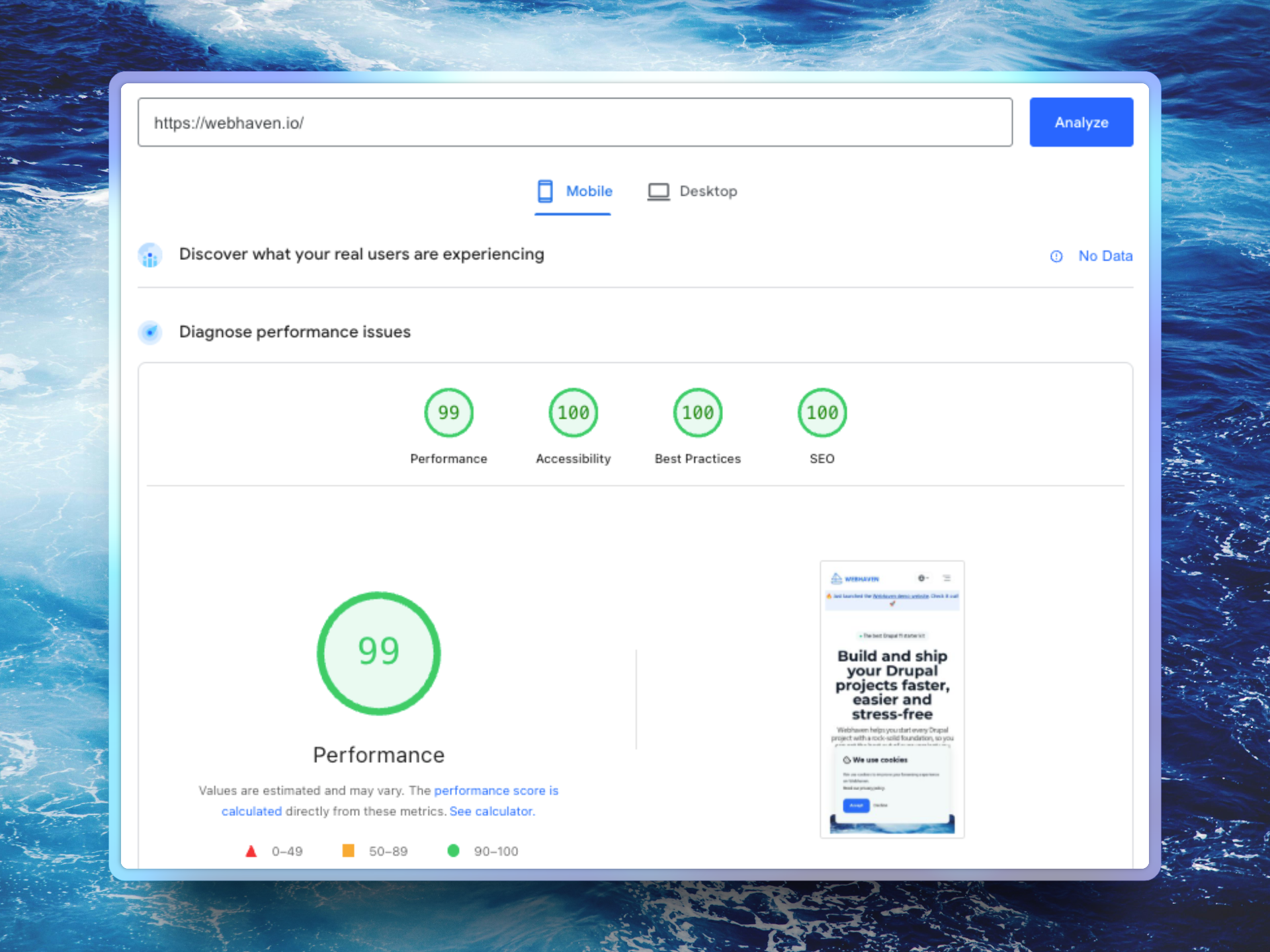
It’s no coincidence that the Webhaven website scores so well in PageSpeed Insights:
My goal is to empower newcomers, learners, experienced developers and agencies to get the best out of Drupal to start every project from the Olympic minimum, which is easy to extend.
That is also the reason why the look & feel of the standard Webhaven theme is professional without frills. I want it to be easy to build your own digital experiences on top of it.
When you go through the Webhaven documentation, the structure and code, the well-thought-out structure and extendibility will be clear.
I’m currently working hard on the Webhaven documentation, which is built-in and built for Webhaven. I hope to release the first version very soon.
TDT[9]: You’ve said Drupal is built for the AI era and linked to Dries Buytaert’s blog post on the topic. In your view, where does Drupal actually have an edge when it comes to AI-driven digital experiences, and where does it still lag behind?
Fons Vandamme: I think Drupal has an edge when it comes to:
- The power of the community
- Structured content by default
- The modular structure that you can extend on
- Drupal’s integration layer, which is part of the core
The biggest lag now and improvement that is on the way is the user experience when creating content. Drupal Canvas, which is in development, will fix this. This will be, in my opinion, a game-changer for Drupal. It’s one of the main reasons why I’ve decided to go all-in on Drupal.
TDT[10]: In your post “Is a personal website still relevant today?”, you question whether it's still worth the effort. Yet you still maintain yours. What do you get out of having a personal site today, beyond what platforms like LinkedIn or Twitter offer?
Fons Vandamme: I believe I should invest more time in writing down the things that occupy my mind, my thoughts and ideas in general.
Charlie Munger put it this way:
“If you get good at destroying your own wrong ideas, that is a great gift.”
There’s a lot of truth in that, and I think the only way to improve is by writing those ideas down and working them through.
Writing also comes with many benefits: it helps train and maintain your focus, strengthens your memory, and it stimulates creativity. On top of that, it supports emotional processing and helps organize your thoughts, leading to more clarity and peace of mind.
In short: I’d have to be crazy not to invest more time in it.
My personal website feels like my playground. A place where I can freely experiment with Drupal, test new modules, and try out creative ideas. It’s also the first website that I created on top of Webhaven.
TDT[11]: You’ve built modules like Sticky, Taggd, and the BugHerd API. What makes you decide that a tool is worth turning into a full Drupal module and releasing to the public, instead of keeping it as an internal or project-specific solution?
Fons Vandamme: I release a module when it solves a problem that I feel others might also encounter.
If it feels like it adds value, beyond my own projects, I always try to share it with the Drupal community.
TDT[12]: You’ve described Webhaven as “the last Drupal website you’ll ever need to build from scratch.” Can this be termed an install profile, or is it a Drupal distribution in your terms? More specifically, what does that mean to you in practice, and how do you see that vision holding up as Drupal continues to evolve?
Fons Vandamme: I see it as a starter, just like Drupal/cms, which has a lot of recipes that you can enable in order to start working on your Drupal project.
The biggest difference with Drupal/cms is that Webhaven is not only pre-configured. It also has all the tools in place to give you the best possible developer experience.
If you want to build your own front-end on Webhaven, that is all baked in from the start because of the Webhaven theme that is component-based (SDC) and can easily be extended on (Starterkit).
TDT[13]: You’ve worked in agencies and on community tools, and now you're starting your first solo endeavour with Webhaven. What do you value most in collaborators, and what kinds of people or skills do you think the Drupal community could use more of right now?
Fons Vandamme: My observation is that Drupal still is very overwhelming for newcomers and learners. I think Drupal could benefit greatly from more content creators.
It will be out of my comfort zone to start creating video content, but I want to help close down that knowledge gap and make it less overwhelming with Webhaven and the Webhaven Academy.
TDT [14]: Over more than a decade with Drupal, what changes have helped it move forward? And what do you think it may have lost along the way, especially in terms of accessibility or ease of entry?
Fons Vandamme: First and foremost, I think the strong leadership, persistence, and vision of Dries Buytaert helped bring Drupal to where it is now (thank you, Dries!). He didn’t do it alone though but he managed to create, inspire and engage the Drupal community as a whole.
One of the pivotal points was the hard and even painful shift from Drupal 7 (procedural) to Drupal 8 (object oriented) and introducing Symfony components as the backbone of Drupal (the proudly invented elsewhere mantra).
As I’ve said in a previous question, Drupal can feel quite overwhelming in the beginning. We need to lower this barrier.
TDT[15]: In your bio, you mention that you enjoy learning while in motion, whether that’s going for a run, cycling through physical or digital fields, or listening to podcasts. Do you find that your best ideas often come when you’re away from the screen? And how do those habits outside of work shape the way you approach building digital experiences?
Fons Vandamme: Totally, I couldn’t agree more.
When I’m behind my computer, I’m mostly just executing. The ideas and plans are shaped when I’m doing other things, which sometimes can be annoying because I write a lot of stuff down on my phone while doing these activities.
But it’s how it works for me. Books, podcasts, exercising and spending time with my family are the fuel to everything that I do.
 Kazima AbbasKazima Abbas is a sub-editor at The Drop Times
Image Attribution Disclaimer: At The Drop Times (TDT), we are committed to properly crediting photographers whose images appear in our content. Many of the images we use come from event organizers, interviewees, or publicly shared galleries under CC BY-SA licenses. However, some images may come from personal collections where metadata is lost, making proper attribution challenging.
Our purpose in using these images is to highlight Drupal, its events, and its contributors—not for commercial gain. If you recognize an image on our platform that is uncredited or incorrectly attributed, we encourage you to reach out to us at #thedroptimes channel on Drupal Slack.
We value the work of visual storytellers and appreciate your help in ensuring fair attribution. Thank you for supporting open-source collaboration!


ASK: Drupal Community Needs Your Support
View all →

Disclaimer: The information provided about the interviewee has been gathered from publicly available resources. The responsibility for the responses shared in the interview solely rests with the featured individual.
Note: The vision of this web portal is to help promote news and stories around the Drupal community and promote and celebrate the people and organizations in the community. We strive to create and distribute our content based on these content policy. If you see any omission/variation on this please reach out to us at #thedroptimes channel on Drupal Slack and we will try to address the issue as best we can.
Related Organizations


Related People

You may also like