



Drupal Leaflet Choropleth Module: Create Interactive Geographic Data Maps Without Custom Code

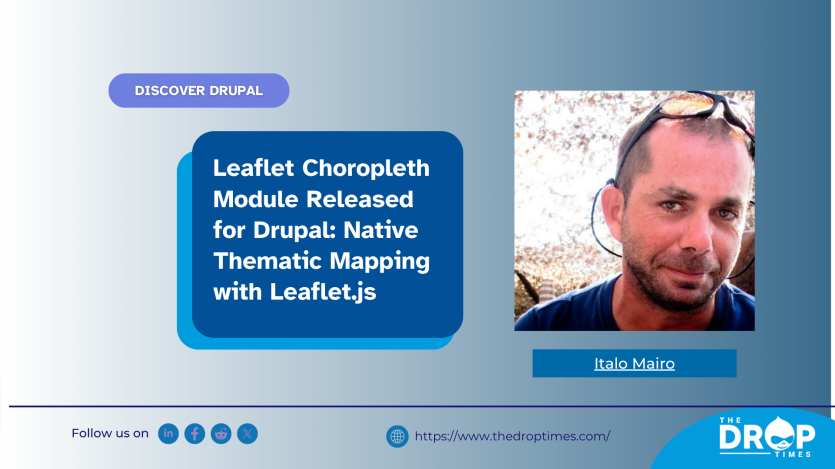
Italo Mairo has released the open-source Leaflet Choropleth module for Drupal, introducing built-in support for thematic mapping directly within the CMS, for the first time. The module enables users to create interactive choropleth maps using Leaflet.js library ("the leading open-source JavaScript library for mobile-friendly interactive maps") offering a native solution for visualizing statistical data by geographic region without requiring external tools or custom development.
Addressing a Significant Industry Need
As the demand for sophisticated data visualization continues to grow across industries, organizations from government agencies and research institutions to media companies and business intelligence platforms routinely work with statistical data that has geographic components. Whether it's election results, census demographics, economic indicators, or public health metrics, the ability to visualize this data through color-coded geographic regions has become essential for effective communication and analysis.
However, implementing robust choropleth mapping functionality has traditionally required complex custom development, expensive third-party solutions, or compromises in functionality and user experience. The Leaflet Choropleth module addresses these challenges by providing a new leaflet_choropleth_map view style plugin that extends the existing Leaflet Views integration, allowing sites already using the Drupal Leaflet module to adopt choropleth mapping without disrupting current workflows or requiring significant infrastructure changes.
Technical Architecture and Vision
The Leaflet Choropleth module builds upon Mairo's longstanding vision of integrating advanced Web GIS functionality with Drupal's robust content management capabilities. As he noted in a 2023 interview with The Drop Times, he was "fascinated by the availability and robustness of [Drupal's] Entities and Fields APIs and the ability to manage them relationally with a backend UI," seeing it as "the natural transposition into a CMS Web product of the peculiarities of GIS software."
The module stands on the shoulders of Drupal's plugin system for data classification and color pattern implementations, offering flexibility, complete customization, and extensibility with other custom modules.
Classification Methods
The initial 1.0.x release includes five advanced statistical classification methods:
- Equal Interval: Divides data ranges into equal-sized intervals, ideal for evenly distributed data
- Geometric Interval: Creates class breaks based on geometric progression, useful for exponential data patterns
- Natural Breaks (Jenks): Employs statistical optimization to minimize variance within classes while maximizing differences between classes
- Quantile: Ensures equal numbers of observations per class, perfect for comparative analysis
- Standard Deviation: Creates classes based on statistical deviation from the mean, highlighting outliers and patterns
The extensible plugin architecture allows developers to implement custom classifiers tailored to specific analytical requirements.
Color Schemes
Effective data visualization relies heavily on appropriate color choices. The module provides carefully curated color palettes:
- Sequential Scales: Single-hue progressions (Blues, Greens, Reds, Grays) for ordered data
- Diverging Scales: Two-color endpoints with neutral midpoints (Red-Blue) for data with meaningful zero points
- Categorical Colors: Distinct colors for qualitative data classification
Configurable Legend System
The module includes a sophisticated and fully configurable Legend as Leaflet Control directly within the map that addresses common usability challenges in web mapping:
- Collapsible Interface: Users can minimize legends to reduce visual clutter, particularly valuable on smaller screens
- Flexible Positioning: Legends can be positioned anywhere on the map interface
- Customisable Content: Full control over legend text, formatting, and styling
- Internationalization Support: Complete integration with Drupal's translation system
Integration and Compatibility
A key strength of the module is its compatibility with standard Drupal content architecture. The choropleth visualization applies only to Entities with Geofield data (polygon or multipolygon geometry types) and numeric fields, requiring no special content restructuring. This makes it accessible to organizations with existing geographic data collections.

Leaflet choropleth layers integrate seamlessly with existing Leaflet mapping features, enabling the combination of choropleth analysis with markers, geometries, and multi-layer map compositions. This flexibility supports advanced data visualizations where multiple layers work together to provide richer, complementary insights.
Use Cases and Applications
The module's versatility supports diverse applications across multiple sectors:
- Government and Public Sector organizations can visualize census data, election results, public health metrics, and infrastructure planning.
- Research and Academia can leverage it for scientific data presentation, demographic analysis, and environmental monitoring.
- Business Intelligence applications include market analysis, sales territory performance, and customer demographics.
- Media and Journalism can use it for data storytelling, election coverage, and investigative reporting.
- Non-Profit Organizations can visualize community impact and resource allocation planning.
Getting Started
Installation follows standard Drupal practices through Composer (composer require drupal/leaflet_choropleth) or via the admin interface by navigating to /admin/modules, searching for "Leaflet Choropleth," and installing.
The module requires the Leaflet module and its Leaflet Views submodule as dependencies, building upon the established Drupal Geofield ecosystem that includes Geofield, Geofield Map, Leaflet and Geocoder modules.
A Live Demo visualizing US States Population Density (Source data: US Census Bureau - July 2011) is available at the Drupal Geofield stack demonstration site, providing users with hands-on experience before implementation.
Development Philosophy and Community Integration
The Leaflet Choropleth module represents a commitment to open-source principles and community-driven development. Currently available as a standalone module for community testing and feedback, the long-term roadmap includes potential integration into the main Leaflet module as a leaflet_choropleth submodule, pending community validation and consensus.
Important Security and Documentation Considerations
Potential users and Organizations should evaluate that this project is not yet covered by Drupal's Security Advisory Policy, due to Drupal.org regulations regarding its recent development & testing phase and its first release deploy. Nonetheless, the module implements Drupal Gitlab pipelines and adheres to Drupal and PHP coding standards, as well as the developer's seniority and experience, ensuring adherence to correct Drupal development and object-oriented programming patterns. Approval for Drupal's Security Advisory Policy coverage will be the next step and a direct consequence of the development quality of this new module.
For detailed configuration instructions and technical documentation, visit the Leaflet Choropleth project page on Drupal.org, or explore the Live Demo to see the module in action.
About the Developer
Italo Mairo (itamair on Drupal.org) is a Civil Engineer who transitioned into digital cartography, combining his natural predisposition for visual arts and photography with computer graphics and digital communication. Originally working extensively with commercial GIS applications like ESRI products (ArcView, ArcGIS), he became one of the first to embrace open-source Web GIS 2.0 solutions when Google Maps APIs and libraries like Leaflet.js revolutionized web mapping.
Since taking over maintenance of the Geofield stack modules during the Drupal 8 transition, Mairo has been responsible for modules with approximately 50,000 adoptions worldwide. As the creator and maintainer of Geofield Map and maintainer of Geocoder, Geofield, and Leaflet modules, he has developed dozens of geospatial solutions. His expertise spans territorial marketing, environmental planning, and e-government applications, with a particular focus on user experience and data visualization quality. In a 2023 interview with The Drop Times, Mairo emphasized his commitment to developing solutions that prioritize the significance of geo-referenced content and usability for end users.


ASK: Drupal Community Needs Your Support
View all →
Disclosure: This content is produced with the assistance of AI.
Note: The vision of this web portal is to help promote news and stories around the Drupal community and promote and celebrate the people and organizations in the community. We strive to create and distribute our content based on these content policy. If you see any omission/variation on this please reach out to us at #thedroptimes channel on Drupal Slack and we will try to address the issue as best we can.

Related People


You may also like