



Can a Pure-Play Drupal Agency Survive? The Case for Reinvention

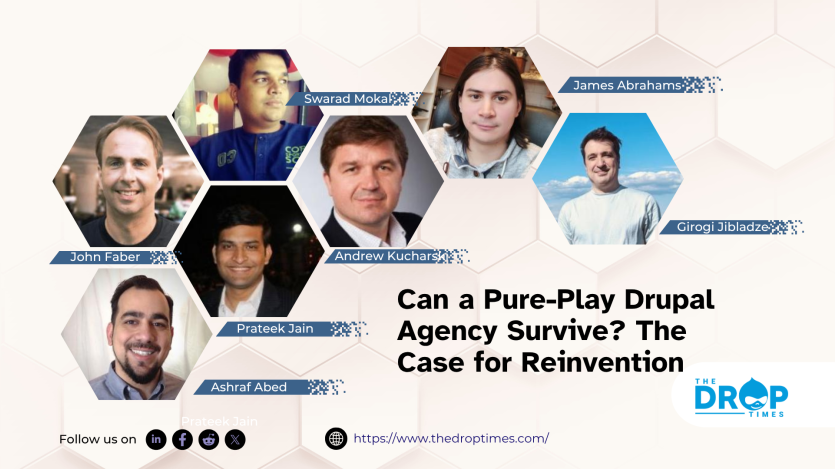
John Faber, Managing Partner at Chapter Three, recently posed a question that many in the Drupal space are no longer confident answering:
Can a boutique, pure-play Drupal agency survive the current market?
The pressures are no longer gradual or isolated. Agencies are facing flat or falling profit margins, rising client expectations, unpredictable pipelines, and a collapse in project value brought on by AI tools and cheaper SaaS competition. The problem isn’t just economic. It’s structural.
“Running a boutique, pureplay Drupal agency has become increasingly complex,” John wrote. “AI is becoming a real competitor to our business model. The notion of a developer hour and what you get for that has shifted.”
He added that most Drupal agencies operate on margins too thin to fund real transformation. They lack financial runway. They are vulnerable to burnout. And many were built for craft, not scale. Only capitalized agencies will be able to pivot, he concluded.
The post drew dozens of responses. Some affirmed the analysis. Others added context, pointed to pivots in motion, or offered opposing views on the potential of AI.
Open Source Under Pressure
Swarad Mokal, Technical Program Manager at Axelerant, supported John’s framing but warned that the opensource model itself increases exposure.
“Agencies working primarily in the opensource space face an even steeper challenge,”
Swarad said. Because AI has had access to high-quality open code, it has improved fast. Closed-source systems might be buffered slightly by licensing walls, but the clock is ticking.
“The window to adapt is closing quickly for everyone in this space.”
Still, Swarad emphasized that human value is still irreplaceable.
“Success will depend less on pure technical implementation and more on how well agencies understand client needs, solve complex problems, and deliver tailored solutions.”
The Challenge Is Bigger Than Drupal
Giorgi Jibladze, CTO and Partner at Omedia, reframed the issue beyond any specific CMS.
“The problem you describe isn’t exclusively about Drupal or its current market trajectory,” Giorgi said. “It’s a broader challenge inherent to the agency business model itself.”
Prateek Jain, Director of Digital Experience Services at Axelerant, agreed. “Doesn't this apply to all agencies, not just Drupal agencies?” he asked. Whether it’s a WordPress shop, a creative studio, or a React consultancy, the same pressure applies. Agencies that aren’t solving real business problems will struggle, regardless of their stack.
Prateek emphasized that while AI can streamline delivery, clients still need human expertise reiterating Swarad.
“Clients still need someone to interpret, advise, and guide them,” he said. “Agencies that evolve into consultative partners, who understand the problem and provide strategic value, will continue to thrive.”
Swarad and Prateek share a core belief: agencies that survive this shift won’t win by building faster. They’ll win by thinking smarter. AI can speed up production, but clients still want context, insight, and trusted interpretation. Building code is no longer the ceiling of value. It’s the floor.
Product Thinking as Survival Strategy
Andrew Kucharski, CEO of Promet Solutions Corp, responded with five concise points. He acknowledged AI’s disruption but focused on a deeper market reality. “There is a SaaS product for that, and it’s cheaper,” he said. The traditional agency model, labor-heavy and margin-thin, can’t compete long-term without change.
“We must build a marketplace and offer SaaS solutions,”
Andrew wrote. He believes agencies must stop billing hours and start selling outcomes, ideally through scalable products supported by automation and AI. He doesn’t dismiss the path forward, but he’s clear that it will take serious time, energy, and capital.
Ashraf Abed, founder of Drupito and lead instructor at Debug Academy, is adapting by working smaller, not larger. His agency focuses on lower-budget Drupal projects and makes them profitable by optimizing workflows. He’s found success with standardized delivery, managed hosting, and process automation. His recent Drupal Camp talk covered the full playbook. The takeaway: efficiency can be a moat.
Drupal’s Strength Isn’t Gone
Randy Kolenko, creator of the Maestro workflow engine, has been working with Drupal since before 2010. He acknowledged that the bottom tier of the market has moved to AI tools and drag-and-drop platforms. But he sees Drupal’s relevance where complexity remains.
“There is still opportunity for robust business web applications to run on Drupal,”
Randy said. Drupal’s future may lie less in websites and more in structured business systems, workflow engines, and advanced integrations.
Can Drupal AI Change the Game?
James Abrahams, Director at FreelyGive Ltd, raised a counterpoint to the bleak outlook. He asked whether Drupal AI could change the trajectory by making larger projects more accessible and scalable for agencies.
John responded directly.
“AI will reduce the development rate to basically zero. The goal of Drupal AI is the same as that of any AI website builder tool: to remove the burden of having to use a development shop, a designer, a migration expert, or a content strategist.”
He believes Drupal AI will shrink agency revenue unless shops adopt new models.
James pushed back. For him, the goal of Drupal AI is not just automation, but expanding Drupal’s ability to solve more complex client problems. He pointed out that AI still lacks true reasoning and that orchestration tools will be needed to make AI work within organizations.
John agreed. “That would be a pivotal point for agencies to learn how to do and make money,” he said. “It is a new business model that requires time, effort, and money to succeed.” He acknowledged that James and others building such tools are contributing to the evolution already underway.
Sarah L., a frontend developer and UI/UX designer focused on AI and accessibility, raised a different concern. "Would government clients and highly regulated industries even allow AI use? “They’re so locked down that everything would need to be cleared through their legal team before they can do a single thing with AI,” she said.
James responded with examples from the insurance sector and the UK’s Ministry of Justice, both of which are moving ahead with AI adoption. “It’s not easy,” he said, “but you can’t be a more security-minded and regulated organisation than insurance." Resistance exists, but so does momentum.
The Conversation Isn’t Over
John Faber’s original post was not a eulogy. It was a wakeup call. The Drupal market has changed. The buyer has changed. The margin structure has changed.
But the need for smart, creative, reliable digital partners has not.
There are even more comments and insights under the original post, each offering a different lens on the same set of challenges. If you want to see the full discussion or add your own perspective, head directly to John’s LinkedIn post and join in.
If you are leading or working inside an agency right now, what are you doing to adapt? Have you shifted your model, your clients, your offerings? Are you building something new or doubling down on what works?
This conversation is far from over. More voices are needed. More ideas are welcome. Let’s keep it going.
 Alka ElizabethMy puns are intended.

ASK: Drupal Community Needs Your Support
View all →
Note: The vision of this web portal is to help promote news and stories around the Drupal community and promote and celebrate the people and organizations in the community. We strive to create and distribute our content based on these content policy. If you see any omission/variation on this please reach out to us at #thedroptimes channel on Drupal Slack and we will try to address the issue as best we can.

Related Organizations





Related People


You may also like