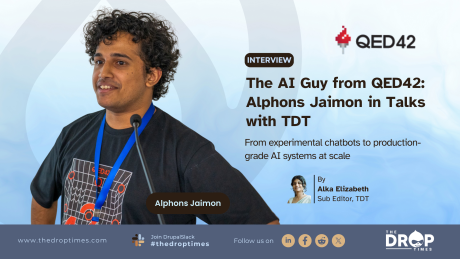




The AI Guy from QED42: Alphons Jaimon in Talks with TDT


When ChatGPT exploded onto the scene two years ago, AI Engineer Alphons Jaimon received a routine client request about semantic search that quickly escalated. What began as a single experiment evolved into multiple production deployments, dedicated AI teams, company-wide training, and ultimately a standalone AI product.
His journey from traditional web development to leading AI initiatives has been, in his own words, "quick, short, quite fun, and packed (with) challenges."
Holding both TensorFlow and Drupal 9 developer certifications, Alphons bridges two worlds that don't always speak the same language. His work spans from building the Illinois Legal Aid chatbot to developing internal AI platforms at QED42, all while maintaining a refreshingly practical perspective on where AI fits in the Drupal ecosystem. He advocates for systems that expose flexible API endpoints rather than cramming everything into a single framework, believing that the best AI solutions often live outside traditional CMS boundaries.
In this conversation with Alka Elizabeth, sub-editor at The DropTimes, Alphons shares insights from his rapid ascent in the AI space, discusses the realities of moving AI from experimental to production-ready, and reveals why he believes the future lies not in flashy AI tools but in seamless experiences that enhance human capabilities. Along the way, he touches on everything from the philosophical implications of consciousness transfer to the practical challenges of managing chatbot costs, offering a unique perspective on the intersection of Drupal and AI.
TDT [1]: Let’s start with your journey. What led you from traditional web development into the AI space, and how did that evolve into your current role at the intersection of AI and Drupal?
Alphons Jaimon: I used to be quite invested in general AI/ML since my college days. We ran small training sessions, fun little projects, and such back in college. Drupal was something new to me. I learned about Drupal and web development during my internship days at QED42. Although I have pivoted to more generalist AI nowadays, I must mention that I hold a Drupal 9 developer certification, so I am well-versed in its elegant architecture.
Around 2 years ago, during the boom of ChatGPT, one of my close seniors asked if we could develop a semantic search for one of our clients. This was the beginning of my AI journey. One experiment evolved into a full-fledged production project, which in turn led to the formation of new AI teams, leadership, practices, initiatives, objectives, company-wide training sessions, and ultimately, an AI product.
So my journey was quick, short, quite fun, and packed with challenges and experiences. Always had to be on my toes with this ever-evolving state of GenAI. I want to drop a little thank you to QED42 and its leadership for helping me become who I am today.
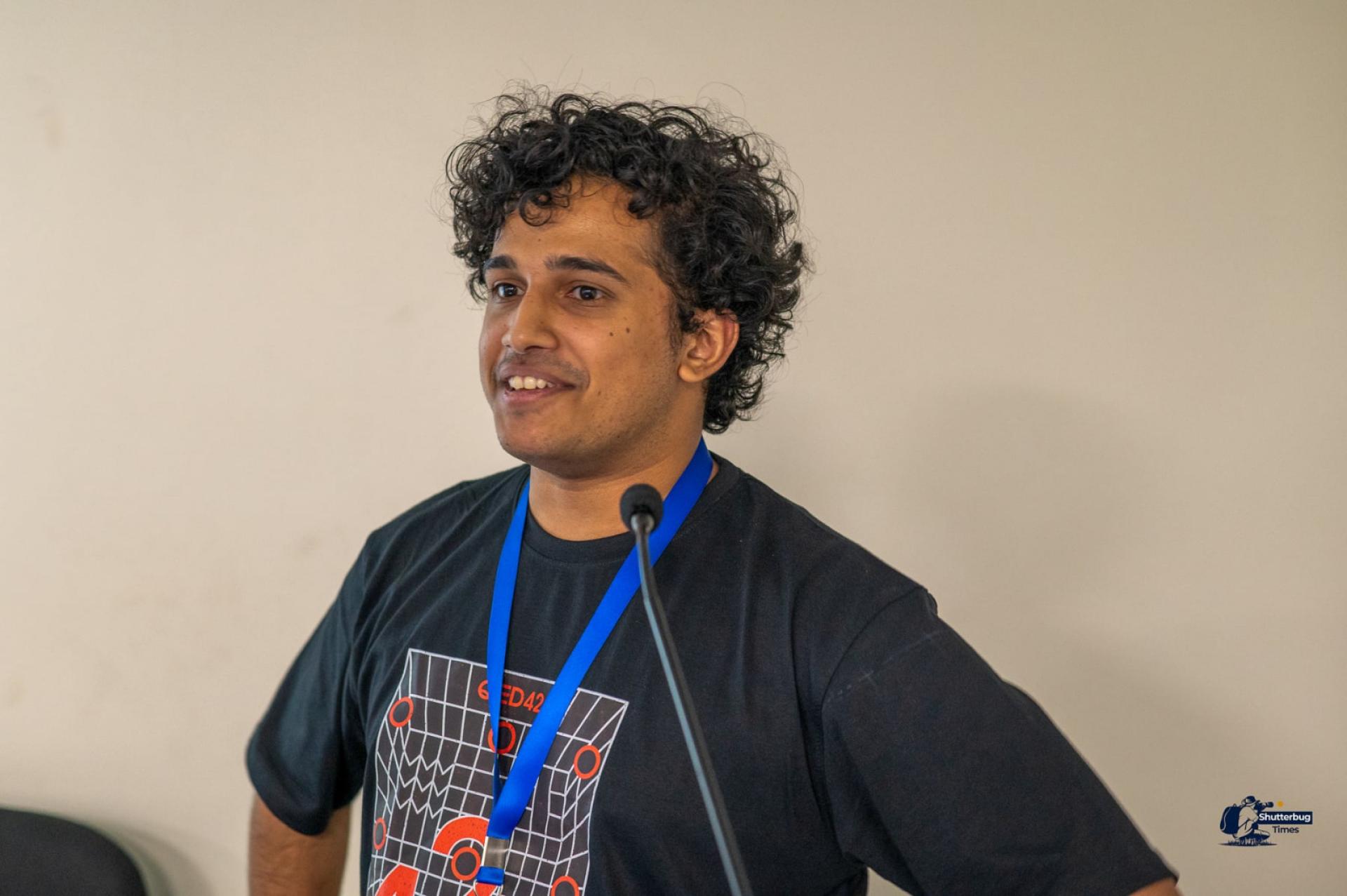
TDT [2]: You’ve been building internal AI platforms at QED42. When it comes to Drupal, how are you seeing AI move from experimental to essential?
Alphons Jaimon: Drupal is a very well-structured data platform. I am not a lot involved in the Drupal AI module development, but I am closely keeping track of its releases and features. I got to appreciate James Abrahams and the team for their amazing work.
I got a slightly different perspective on Drupal AI. The way it's built, there are places for improvement, and I wouldn't like anyone to compare it with things like langgraph, langflow, langchain, and such frameworks and libraries that pretty much do the same. Drupal AI does make the whole integration of all fancy AI tools and such much easier for a new Drupal user. But there are things like latency between different actions and the overall experience that are not really personalised for a single specific client. As usual, you are required to develop your UX around it. But it will take quite some time and resources to reach the flexibility that Drupal core provided for its developers since D8/9.
I stand by my notion that Drupal AI is your go-to experiment toolkit. But when going to production in most situations, the client doesn't need a million tools and agents flipping around million-dollar tasks like it's just hamburgers. In my many limited conversations I have had with our clients, there is one pain point and one good solution around it, which is often way more straightforward than what Drupal AI covers.
Just reiterating, Drupal AI is a good experimental base. Once you get your desired UX, you can either maintain that or switch to a much smaller, faster, and manageable API of sorts. (These systems that I talk about can still be sovereign systems owned by the clients.)
TDT [3]: Your work on the Illinois Legal Aid chatbot and semantic search is impressive. What were some of the hardest decisions you had to make when integrating AI into that Drupal-based system?
Alphons Jaimon: “Hardest” might not be the right term, I would say, “fun and challenging”. Since the ILAO (Illinois Legal Aid Online) Chatbot & Search experiment began before Drupal AI initiatives and modules, we developed a system that simply exposed a load of really fast and flexible API endpoints that would work with Drupal or any CMS in the future.
Before I delve into the challenges, I would like to briefly explain the system (without going into detail due to IP concerns) so that you can gain a better understanding while navigating the fun challenges.
So the system contains like four core ingredients:
- Data ingestion pipeline: One of the most important aspects of the whole system, how you represent the data in the vector store or to the chatbot pretty much defines the quality of the whole system. In simple terms; gold in, gold out, garbage in, garbage out. Data is like gold for LLMs and quite literally any AI system today. So our data pipeline contains a lot of different processes that slightly modify the data for optimal retrieval.
- Vector Storage: For our vector store, we opted for an open-source, fast, and flexible solution. Due to IP reasons, I won't be able to share the exact config. However, it's something we selected after conducting extensive research. And tailored config specifically benefiting ILAO’s data size and use case.
- Chat Handlers: Our chatbot prompt is approximately 3.2K tokens, which is quite large. Includes a range of dos and don'ts, instructions, tone, and guidance on how to handle various scenarios, making it quite complex, I would say.
- The final piece is the Guardrails: A good production system requires robust security. The guardrails here block queries unrelated to the ILAO domain, and in some situations, even provide the user with more relevant query suggestions.
A few of our interesting challenges that I can recall were:
- The chat alignment was actually quite a lengthy process. Once our system entered QA mode, we began facing numerous inconsistencies in responses. The main guiding prompts underwent numerous iterations, and client testing also significantly aided the process. Aspects such as truth & tone were among our most enjoyable aspects to align. Guardrail systems were developed as part of this alignment process.
Another fun thing was how we could manage long chats while keeping the costs down. No chat summarising was worth it, so we programmatically developed a few methods that switch in when the chats start getting longer. One of the easiest ones I can share is simply trimming the old retrieved data from the message array.
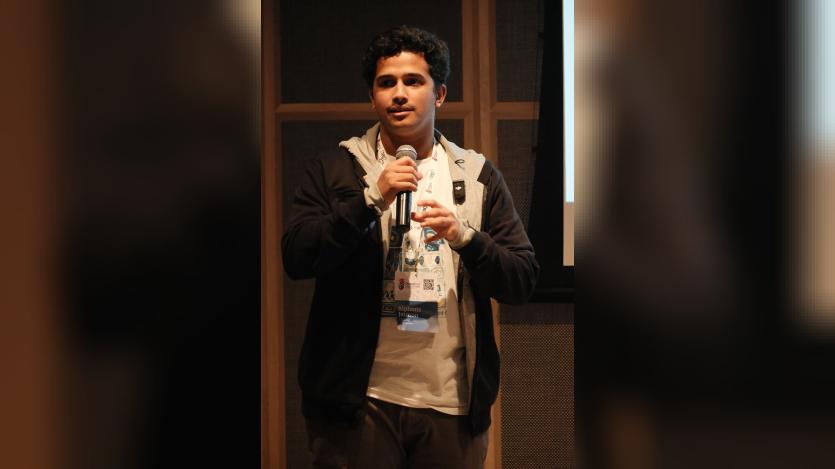
Alphons Jaimon | Alphons Jaimon
TDT [5]: You’ve mentioned using Rust for building backend systems. Since most Drupal work is still grounded in PHP, do you ever use Rust alongside Drupal, especially when building AI services? If so, how do you bridge the two?
Alphons Jaimon: Rust was used in one of my early versions of the AI systems we developed in-house. I had to switch to Python for the sake of general long-term maintainability. However, in both situations, whether in Rust or Python, the Drupal end was consuming an API that was developed from the ground up, prioritising integration flexibility as a primary consideration. As I mentioned earlier, Drupal is a good datastore, and I prefer to keep complex user-facing processes separate from it.
TDT [6]: You often experiment with new AI ideas and tools. How do you manage rapid prototyping in a Drupal environment that tends to be more structured and stable?
Alphons Jaimon: Drupal AI provides you with minimal tools to run many different experiments, and then there are always no-code builders that expose an OpenAI-compatible endpoint, which can be consumed in Drupal today with ease. To try out any quick AI tools, it's best to start with HuggingFace Spaces, followed by some online Google Colab notebooks, and finally some notebooks running locally. Drupal would come a bit later in the experiment stages.
TDT [7]: During your Drupal Meet session in Pune, you introduced tools like Flowise and Ollama to simplify chatbot development. What did you learn from seeing participants build with these tools for the first time, and did it challenge any assumptions you had about AI accessibility?
Alphons Jaimon: Tools like Flowise and Ollama were really single-user focused and not that optimised for prod scale. My point in those sessions was to provide hands-on experience for completely new developers and explorers in building small, context-aware chatbots and similar applications. These are perfect experiment systems, plug and play, with loads of different integrations and features. Try out how different kinds of outputs work for you, and determine which flow is the perfect combination for your UX. But when going to prod and you wanna serve a million users or so, I would suggest keeping these flow builders out of your system, they are often a million wrappers around wrappers and too many library dependencies, making them a difficult choice to maintain in the long run and sometimes even scale and adapt with the need.
One of the biggest challenges I observed among my participants and fellow individuals is the difficulty in conveying the full extent of the UX shift that this GenAI tech brings. Very few companies today employ AI in production, and most of them don’t market it to users as AI; it simply becomes part of the experience, which users are already accustomed to. It’s difficult, and we all know that, but that's the kind of challenge one needs to solve—something that actually matters and changes one's life without having to learn the ropes.

TDT [8]: Looking ahead, where do you see the biggest opportunity for Drupal and AI to work together in ways we haven’t fully tapped yet?
Alphons Jaimon: Just saying it again, Drupal is a good data store. So, having AI assist with tasks that a data store typically performs or manages, such as metadata, content optimisation, and content transformations for various systems, is very useful and adds value without compromising the user experience.
I am personally waiting to see how the AI Core and Initiatives turn out; either it could be something really robust and production-ready in the long term, or it could end up being just another laggy flow builder. I hope for the best. As far as I know, these new funded initiatives are targeting the content authoring experience, which might actually be in the right direction, transforming data before it faces the end users. As we also see the rise of decoupled sites, folks might want to keep their heavy AI layers completely separated and not too closely coupled with other disjointed parts of the site.

TDT [9]: Your interest in consciousness transfer and AI’s philosophical implications stands out in a very applied engineering role. How do you reconcile that curiosity with the day-to-day realities of shipping production-grade AI solutions for clients?
Alphons Jaimon: Haha, very interesting question. A lot of my friends ask something along these lines every time I mention what my dream is. Some say just grow up and think real. But is something that could be done tomorrow really a dream that I wanna hold forever? I think not. Does “Colonising Space” sound like a more real dream than “Consciousness Transfer”? I don’t think so. This dream started from a 2015 movie called “Chappie”. In this movie, some humans transfer their consciousness to a robot. Recently, there was an anime called “Pantheon” which depicts my dream better, uploading consciousness to networks instead of any physical body. I occasionally spend time learning and exploring these topics, which can be too difficult to digest, but are worth it. Call me delusional, but dreams like these keep me going through difficult times. I hope to work out a transition to a different domain in the coming years.
 Alka ElizabethMy puns are intended.
Image Attribution Disclaimer: At The Drop Times (TDT), we are committed to properly crediting photographers whose images appear in our content. Many of the images we use come from event organizers, interviewees, or publicly shared galleries under CC BY-SA licenses. However, some images may come from personal collections where metadata is lost, making proper attribution challenging.
Our purpose in using these images is to highlight Drupal, its events, and its contributors—not for commercial gain. If you recognize an image on our platform that is uncredited or incorrectly attributed, we encourage you to reach out to us at #thedroptimes channel on Drupal Slack.
We value the work of visual storytellers and appreciate your help in ensuring fair attribution. Thank you for supporting open-source collaboration!


ASK: Drupal Community Needs Your Support
View all →

Disclaimer: The information provided about the interviewee has been gathered from publicly available resources. The responsibility for the responses shared in the interview solely rests with the featured individual.
Note: The vision of this web portal is to help promote news and stories around the Drupal community and promote and celebrate the people and organizations in the community. We strive to create and distribute our content based on these content policy. If you see any omission/variation on this please reach out to us at #thedroptimes channel on Drupal Slack and we will try to address the issue as best we can.
Related Organizations

Related People
Related Drupal Initiatives

You may also like