



Drupal Public Data, Statistics & Silver Linings? An Exploration #4


This is part 4 of a 5-part series examining Drupal public data in search of actionable insights
Preamble
Previously, this article presented and analyzed Drupal installation data. It introduced ideas from economics, statistics and mathematics in order to construct models that might "fit" the data, with increasingly encouraging results. Drupal 7 has been a consistent outlier in this exercise. This installment further analyzes the data with an emphasis on Drupal 7. It also provides supplementary information drawn from communications concerning Drupal 7 and people's personal experiences regarding how the Drupal Project conducted itself around Drupal 7.
Drupal Release Spacing
In its very earliest days, the Drupal Project had no formal Edition release policy. New Editions were released on an as-needed basis, usually driven by enhanced functionality or security considerations. As the Drupal Project matured, it began to release Editions less frequently.
Now, the Drupal Project has formally committed to a 2-year (730 day) release cycle. For many customers, this policy is most welcome as it lends needed predictability and consistency to their own budgeting, planning and operations efforts.
The following table details the actual release spacing, in days, of various Drupal Editions against its self-imposed 730 day release cycle:
* Projected as per Drupal announcements
Figure 8: Drupal Edition Actual Release Spacing
Presented graphically, Edition spacing looks like this, demonstrating that a remarkable amount of time passed before Drupal Editions 5, 8, and 9 were released. Drupal 7 ranks 4th in this regard.

Drupal Release Variance
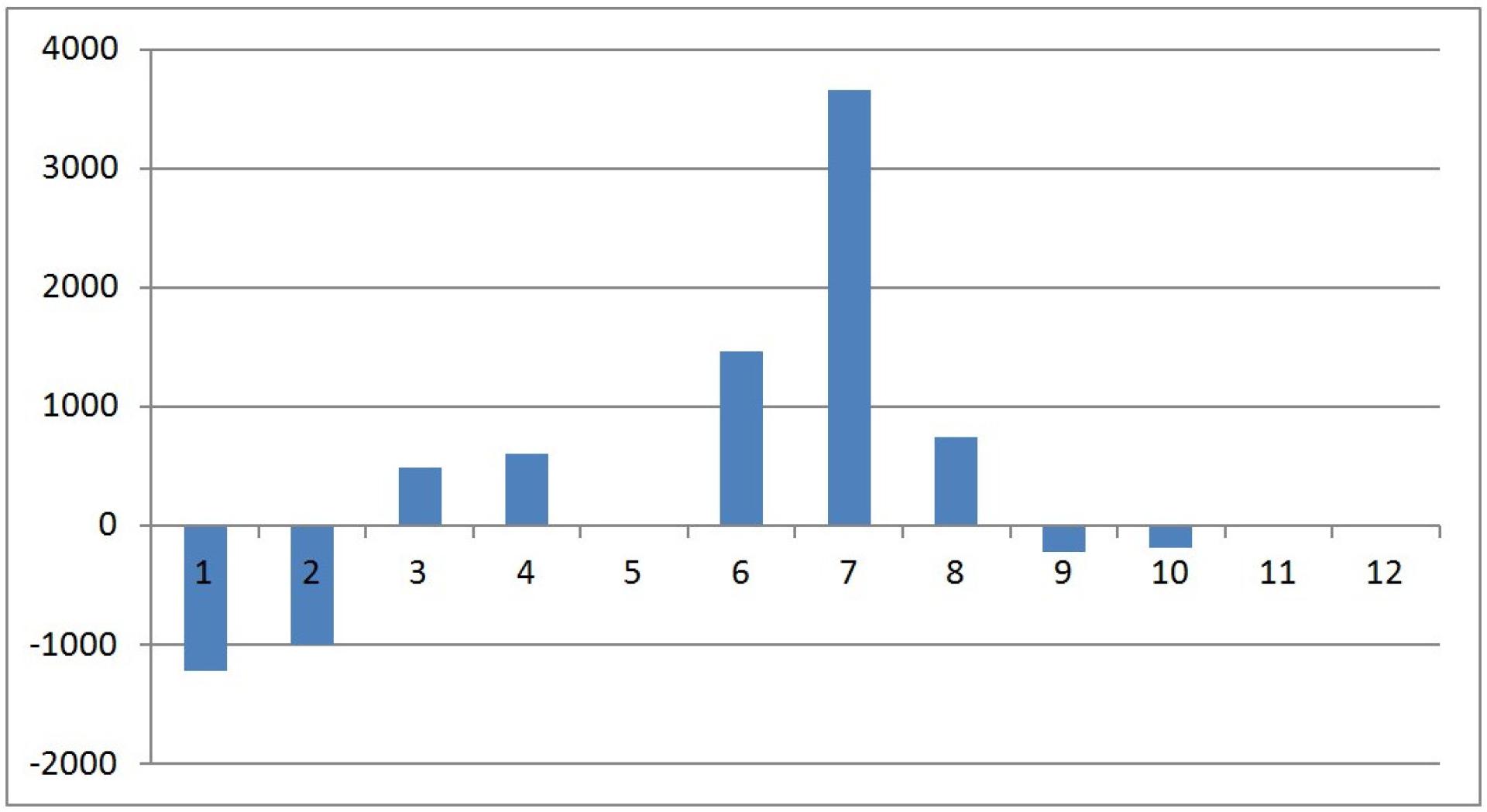
The following table details the variance, in days, of different Drupal Editions against its self-imposed the 730-day release cycle:
* Projected as per Drupal announcements
Figure 9: Drupal Edition Actual Release Variance
When presented graphically, what stands out is the following: About half of all Drupal Editions were released early, with more than half of the early releases occurring prior to Drupal 7. Interestingly, the two most recent releases of Drupal have happened early, which is somewhat odd for a mature product. Finally, it appears that the Drupal Project has never been able to hit its self-imposed 730-day release cycle, despite having stated this as a formal policy for many years.

Edition Support Policy
Ten years ago, people were already discussing the Drupal "two versions back" support policy as a well-established (albeit informal) understanding. As explained in those communications, support for Drupal 5 stopped with the introduction of Drupal 7, support for Drupal 6 would stop with the introduction of Drupal 8 and so on. More recently, Drupal has formalized this policy, meaning that the maximum Service Life for any Drupal Edition is now 1460 days.
The following table details the actual Service Life of various Drupal Editions:
Drupal Edition Actual Service Life
* Projected as per Drupal announcements
Figure 10: Drupal Edition Actual Service Life

Presented graphically, the Service Life of Drupal 7 towers over every other Edition. Also, the only time the Drupal Project was able to hit its 1460 day Service Life target was with respect to Drupal 5.
Drupal Service Life Variance
The Drupal Project was never able to demonstrate any real conformity to its self-imposed release cycle target of 1460 days.
The service life of various Drupal Editions is presented in the table below:
* Projected as per Drupal announcements
Figure 11: Drupal Edition Actual Service Life Variance
Drupal Edition Service life variance is marked, with Drupal 7 once again towering above all other editions and Drupal 5 almost perfectly hitting the target. Aside from that, a pendulum-like pattern emerges, with the Service Life swinging from too short, to too long and then back to too short again.
EDA #5: First Impressions Regarding the Drupal 7 "Situation"
The Drupal 7 situation is remarkable. While it is somewhat normal (even expected) for a new software title to display an erratic release schedule early in its developmental arc, it is not normal for the 7th edition of a software to exhibit such behavior. Despite all efforts on the part of the Drupal Project, Drupal 7 website owners did not opt to upgrade. With these findings confirmed, the only remaining question is to find out why. It's time to start talking to people.
What Factors Contributed to the Drupal 7 Situation?
It is still possible to communicate with the Drupal 7 community. In the historical record, voluminous information exists in the form of memorialized discussions surrounding Drupal 7, and many people who were active with Drupal 7 then are still alive today, with their memories somewhat unfaded. Following a review of historical communications and talking to people who were active at the time, the following themes emerged with respect to Drupal:
- The early community around Drupal was small, expert and trusting. They complied with upgrade announcements because they brought more than justified improvements.
- As Drupal matured and became more complex, so too did the websites built with it. There was an explosion of usefulness, especially in the 3rd party contributed modules area.
- Many people were happy with Drupal 6 and felt no pressing need to upgrade to Drupal 7. This was the first time that "questioning the upgrade" really began to happen.
- Many Drupal 7 early adopters did not experience the relatively easy upgrade they expected. Instead, they found themselves trapped in a disruptive, lengthy and expensive re-implementation of their Drupal 6 website, often one with less usefulness than before.
- The slow pace of 3rd party contributed modules being upgraded from Drupal 6 to Drupal 7 forced many non-expert website owners to defer their Drupal 7 upgrade for years.
- Many Drupal 7 website owners watched Drupal 8 early adopters struggle to upgrade, which once again morphed into re-implementations. The issue of 3rd party contributed modules not being upgraded fast enough continued to manifest itself.
- Drupal 8 was declared EOL in November 2021 because its base framework (Symphony 3.x) went EOL. The same thing happened two years later to Drupal 9 when its base framework (Symphony 4.x) went EOL. These technology-driven retirements introduced new notes of doubt and uncertainty regarding who was really in control of Drupal EOL policy.
- The Drupal 7 community was left further and further behind, but little help was forthcoming from the Drupal Project other than the message that re-implementations were the only way.
- All the while, Drupal 7 based websites continued to function. Many still do, even to this day.
The result was feelings of powerlessness, suspicion, abandonment, uncertainty and, ultimately, fear on the part of the Drupal 7 community. This culminated in paralysis that may have been misinterpreted on the part of the Drupal Project as stubbornness or intransigence. But those emotions are not fear. They don't even emanate from the same place in the brain.
The next piece in this series examines the two obvious choices that the Drupal Project had before it regarding the Drupal 7 situation. It introduces new information and analytical models drawn from biology, psychology and economics to help explain and contextualize those choices, revealing markedly different but individually promising outcomes (or “silver linings”) for the Drupal Project. The article concludes with the introduction and discussion of an alternative model for innovation-oriented enterprises, informed by theory and confirmed by empirical observation, that they might choose to employ when engaging in stakeholder-oriented strategic planning.
In 2002, Professor Graham Leach began lecturing at Hong Kong Polytechnic University, the largest school in Hong Kong, by teaching graduate level courses in the Department of Computer Science of the School of Engineering. In 2010, he moved over to the School of Design and remained there until his retirement in 2023. Graham currently occupies a Professorship of Entrepreneurship in the School of Business of the newest Tertiary institution in Hong Kong, Gratia Christian College.
 Professor Graham LeachInnovation Commercialization Specialist
Image Attribution Disclaimer: At The Drop Times (TDT), we are committed to properly crediting photographers whose images appear in our content. Many of the images we use come from event organizers, interviewees, or publicly shared galleries under CC BY-SA licenses. However, some images may come from personal collections where metadata is lost, making proper attribution challenging.
Our purpose in using these images is to highlight Drupal, its events, and its contributors—not for commercial gain. If you recognize an image on our platform that is uncredited or incorrectly attributed, we encourage you to reach out to us at #thedroptimes channel on Drupal Slack.
We value the work of visual storytellers and appreciate your help in ensuring fair attribution. Thank you for supporting open-source collaboration!


ASK: Drupal Community Needs Your Support
View all →
Note: The vision of this web portal is to help promote news and stories around the Drupal community and promote and celebrate the people and organizations in the community. We strive to create and distribute our content based on these content policy. If you see any omission/variation on this please reach out to us at #thedroptimes channel on Drupal Slack and we will try to address the issue as best we can.

Related People


You may also like