



"We are the Navigators Charting the Future of Open Web" - Dries Buytaert

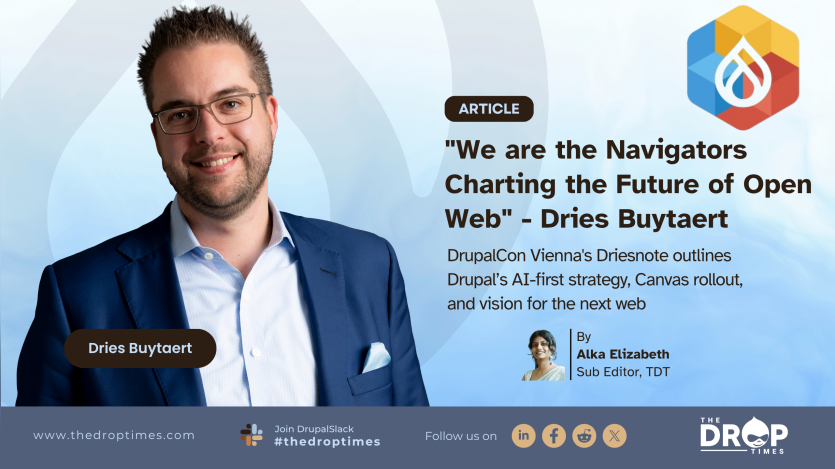
DrupalCon Europe 2025 has officially begun in Vienna, and the most anticipated keynote, popularly known as Driesnote, has been delivered. Dries Buytaert opened DrupalCon Vienna 2025 not with a feature showcase, but with a confrontation. The title of the keynote, “The Map of the Web Is Being Redrawn,” was not metaphorical for its own sake, it was literal, strategic, and philosophical all at once. The old structures of the web, built on search engines, organic discovery, and multi-click journeys, are crumbling under the weight of artificial intelligence and the central question he posed was blunt:
“What’s going to happen to Drupal in a world full of AI?”
The answer was layered, but clear in its intent. Drupal is not retreating. It is evolving. Not incrementally, but foundationally.
From the Battle of Austerlitz to the AI Battleground
Dries began with a historical detour to an early Vienna ruled by many empires, but taking a halt at Napoleon winning the Battle of Austerlitz, and William Pitt, the Younger lamenting that a map had become useless overnight. The point was clear. Moments of disruption render old models irrelevant. Artificial intelligence is not another wave of tech innovation. It is a structural rewrite of how people use the web.
"We are in a period of tremendous change and the web that we have known for the past 30 years is no more," added Dries
The implications are existential. More than two-thirds of all web searches now end in zero clicks. As AI systems increasingly deliver direct answers, the traditional role of a website is under question. If users are not clicking, why publish? Why design? Why structure content?
Dries confronted this head-on. He made the provocation clear, then rejected defeatism. The mission is not just to survive the shift. It is to shape what comes next. "AI is the storm, and the way to survive is through it.” This was the orientation. And from that orientation, he moved to action.
Canvas and the Tools for a New Web
The past 18 months were presented as Drupal’s most productive in years. That claim was substantiated not by hype, but by numbers. Contributions have doubled since 2023. The Starshot initiative, launched to focus community effort around accelerating adoption, sparked this resurgence. The result is Drupal Canvas, a visual site builder that aligns technical power with usability. It is not a gimmick or bolt-on interface. Canvas is Drupal repositioned for creators, marketers, and enterprise users without diluting its structured core.
Canvas is not a standalone tool. It works in tandem with several new systems that define Drupal’s next phase. These include site templates, which provide full, launch-ready Drupal sites with content models, features, and sample data. Recipes allow users to choose key features like multilingual support or accessibility at install time. Code Components let front-end developers build reusable, interactive blocks using modern JavaScript without needing to decouple. A prototype Figma-to-Canvas integration was also demonstrated, pointing to a more connected workflow between design and development.
Underpinning all of this is Mercury, Drupal’s new design system. It provides a unified set of layout structures, reusable components, and visual standards that ensure consistency across templates and tools. The Byte site template, shown during the keynote, is built entirely with Mercury and demonstrates how design and structure now work together out of the box.
Mercury brings visual clarity and standardization to Drupal's front end, making the output of Canvas not just functional, but well-designed from the start.
The Marketplace: Distribution with Standards
The innovation extends beyond tooling into structure and strategy. What Dries proposed in his previous keynote as a possibility has now been formalized. The Drupal Site Template Marketplace is no longer a concept, but a funded and active initiative. It aims to provide a scalable, high-quality distribution channel for site templates that can serve both commercial and community needs.
The initial release will feature a curated set of free and paid templates submitted by certified partners. These offerings will meet baseline standards for accessibility, security, demo content, and documentation. Over time, the Marketplace is intended to open further, inviting designers and agencies to contribute directly using no-code export tools built into Canvas.
This effort blends commercial opportunity with open-source principles. Templates will remain GPL-licensed, and governance will stay community-based, while the experience is shaped to meet the expectations of modern users looking for reliability, speed, and quality at launch.
AI: Not a Feature, a Framework
The AI section of the keynote was expansive and critical. Dries presented AI not as a novelty, but as a core layer of Drupal’s future. The Drupal AI Initiative, launched just five months ago, has already secured one million dollars in combined cash and FTE contributions from 22 global partners.
What has emerged from this initiative is a suite of integrated, functional AI tools designed to enhance the site-building and content-authoring process:
- AI Page Generation: Allows users to create full landing pages based on prompts and pre-defined brand rules.
- Context Control Center: A configuration interface that lets teams define their brand voice, audience personas, key messages, and content rules. This context is injected into all AI tasks, ensuring content is not just generated, but aligned.
- Autonomous Drupal Agents: These agents operate in the background. They detect updates, flag inconsistencies, suggest changes, and initiate drafts with full audit trails and human review checkpoints.
Dries emphasized that this is not about full automation. It is an augmentation. AI in Drupal exists to assist the creator, not replace them. It is Drupal’s structured foundation, revisioning, content modeling, permissions that makes this kind of safe AI integration possible.
Orchestration: Drupal as a Digital Operations Hub
In one of the most forward-looking segments, Dries introduced the concept of Drupal Orchestration, positioning Drupal not just as a CMS, but as a control plane for digital operations.
This is powered by two systems:
- ECA (Event-Condition-Action): An internal Drupal tool for triggering workflows and automating actions based on site behavior.
- ActivePieces: An open-source integration platform that connects Drupal to hundreds of external tools and APIs, including ChatGPT, Google Sheets, Slack, and WordPress. (Their website boasts integration between 443 different software tools)
The demo showed content being imported from a WordPress RSS feed, processed by AI to match Drupal terminology, filtered for relevance, and pushed into a moderation queue. All of this happened automatically, with checkpoints for human review.
The vision is to blend deterministic logic with probabilistic AI outputs. Not to hand over control, but to multiply what’s possible. ECA is also being reimagined for broader adoption, with its creator Jurgen Haas redesigning the interface to make it easier, faster, and more visual. This has the potential to become the next Views, a default expectation in the toolkit of every Drupal site builder.
Dries framed this combination of internal orchestration and external automation as the early shape of DXP 2.0. It is a new model for digital experience platforms that are open, extensible, and AI-augmented by design.
The Roadmap: From Idea to Impact
Dries outlined a phased rollout of Drupal’s next era:
- Drupal Canvas 1.0: November 2025
- Drupal CMS 2.0: January 2026, featuring Canvas as the default experience
- Marketplace MVP: March 2026, with template expansion tied to DrupalCon Chicago 2026
- Drupal CMS 3.0: To follow, focusing on adoption, accessibility, and easier hosting
This roadmap is not just a list of features. It reflects a strategic repositioning. Drupal is no longer just a tool for developers. It is being rebuilt as a platform for creators, agencies, enterprises, and newcomers alike.
In traditional Drupal fashion, the rollout begins with a community celebration, followed by a global marketing push to showcase what Drupal has become.
Websites Still Matter
Dries closed with clarity. In a web reshaped by AI, where clicks are vanishing and content is instant, he drew a firm line around what still matters.
“Websites are where ownership, identity, and creativity live.”
No chatbot can replicate the feeling of navigating a site built with care. No prompt can replace the nuance of brand voice, layout intention, or the trust conveyed through structure and design. Drupal is placing its bet on a future that still needs human-centered digital spaces, not just algorithmic answers.
This keynote was not an attempt to catch up or compete on hype. It was a deliberate statement of where Drupal is headed, grounded in real tools, a live roadmap, and a shared commitment to building with purpose.
Before stepping off stage, Dries thanked the many contributors who made this work possible. The message was clear. Drupal is not waiting to adapt. It is already shaping what comes next.
 Alka ElizabethMy puns are intended.
ASK: Drupal Community Needs Your Support
View all →
Note: The vision of this web portal is to help promote news and stories around the Drupal community and promote and celebrate the people and organizations in the community. We strive to create and distribute our content based on these content policy. If you see any omission/variation on this please reach out to us at #thedroptimes channel on Drupal Slack and we will try to address the issue as best we can.

Related Drupal Initiatives


Related Events


Related People


You may also like