



The Human Edge in Presales: Beating AI-Drafted Drupal Proposals

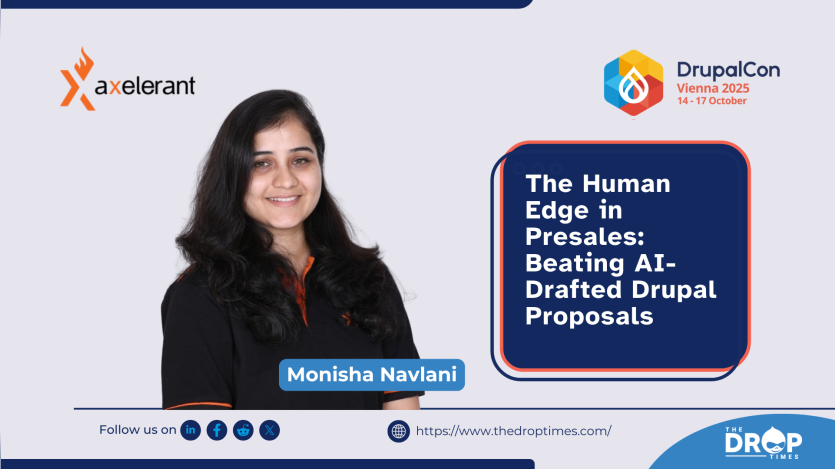
Editor's Note: This article is a guest contribution by Monisha Navlani of Axelerant. The article is based on her session “The Human Edge in Presales: Beating AI‑Drafted Drupal Proposals” at DrupalCon Vienna 2025. Monisha explores how Drupal agencies can distinguish themselves in an AI-saturated proposal landscape by leaning into human judgement, specificity, and trust.
In the past year, AI has transformed how Drupal agencies approach presales. Tools that once took hours—RFP analysis, boilerplate drafts, and proposal formatting—now happen in minutes. The result is incredible efficiency. But there's a catch: when every agency can produce a polished, “perfectly structured” proposal at lightning speed, everything starts to sound the same.
That sameness—the AI noise—is exactly what my DrupalCon Vienna session explored. It's no longer enough to submit a well-written proposal. Winning agencies are now distinguished not by how fast they can draft, but by how deeply they can connect—through context, trust, and storytelling.
Why Now: The AI-Drafted Proposal Era
Drupal's service landscape is changing. Clients expect modular, composable solutions. Procurement cycles are longer, budgets are tighter, and RFPs are more complex. Against this backdrop, AI has become a presales accelerator—scanning documentation, retrieving answers, and generating “good enough” drafts at scale.
Yet what buyers increasingly report is fatigue. They see the same phrasing across proposals: “secure, scalable, user-centric Drupal experiences.” They skim, they bounce, and they move on. The irony is clear: as AI makes it easier to write, it's made it harder to stand out.
Where AI Helps and Where Humans Win
AI absolutely has a role to play. It's invaluable for structure, consistency, and speed:
- Building the skeleton of a proposal
- Fetching approved boilerplate content
- Checking terminology and compliance
- Rapidly adapting tone or length for different audiences
But AI cannot feel risk. It can't read the political map in a client's organisation, or tell when a stakeholder's silence means resistance. It doesn't know what happened in that near-miss project last year or how you grew from it. Those nuances, the ones that build trust, remain deeply human.
That's why the most effective presales teams use AI to augment, not replace, their judgment. They use it to handle the repetitive and let people focus on what AI still can't: context, empathy, and credibility.
How Reviewers Spot AI-Written Proposals
During the session, I shared how proposal reviewers can now detect AI-authored content in seconds. The clues are easy to spot:
- Over-polished “marketingese” and generic nouns
- No mention of real-world specifics—org charts, system constraints, or past issues
- Inconsistent tone or brand mismatches
- Boilerplate without proof—no names, URLs, or examples
To illustrate the difference, we compared two paragraphs.
AI-drafted: “Our comprehensive Drupal expertise enables scalable, secure, and user-centric solutions. Leveraging best practices, we ensure seamless migrations and optimised performance.”
Human-crafted: “Your current Drupal 9 setup handles ~8k nodes and spikes 3× during March campaigns. We'll keep your editorial shortcuts, cut media lookup time by ~40% with a taxonomy re-map, and ship a dry-run migration in week 3 so your team can test before production.”
The second one wins because it's painfully specific: proof-driven, not promise-driven. That's the human edge.
Five Human Moves That Win
From Axelerant's experience and community feedback, five habits consistently separate great presales professionals from AI-powered autopilot:
- Brave transparency: Admit, “We haven't done this yet, but here's exactly how we'll figure it out.” It builds long-term trust.
- Sharper questions: Ask what's missing from the RFP, not just what's written in it.
- Relevant storytelling: Share one story that mirrors the client's risk—especially a near-miss that taught you something.
- Early trust signals: Send a sandbox link or a short demo video.
These actions demonstrate ownership, humility, and confidence—qualities that no algorithm can convincingly imitate.
At Axelerant, every deliverable ends with a human owner saying, “I'd stand behind this.”
The Takeaway for Drupal Agencies
You can't out-robot the robots. But you can out-human them.
In a marketplace crowded with automation, the human edge has become the competitive advantage—the ability to understand context, interpret emotion, and build trust through authentic dialogue.
AI can write faster. Only humans can write something worth reading and believing.
Watch the full session:
 Monisha NavlaniI run digital transformations at work and a tiny jungle at home.
ASK: Drupal Community Needs Your Support
View all →
Disclosure: This content is produced with the assistance of AI.
Note: The vision of this web portal is to help promote news and stories around the Drupal community and promote and celebrate the people and organizations in the community. We strive to create and distribute our content based on these content policy. If you see any omission/variation on this please reach out to us at #thedroptimes channel on Drupal Slack and we will try to address the issue as best we can.

Related Event Sessions


Related Events



Related Organizations

Related People


You may also like