



“Community is How We Compound Progress” — The Developer Behind the London Drupal Engineering Meetup

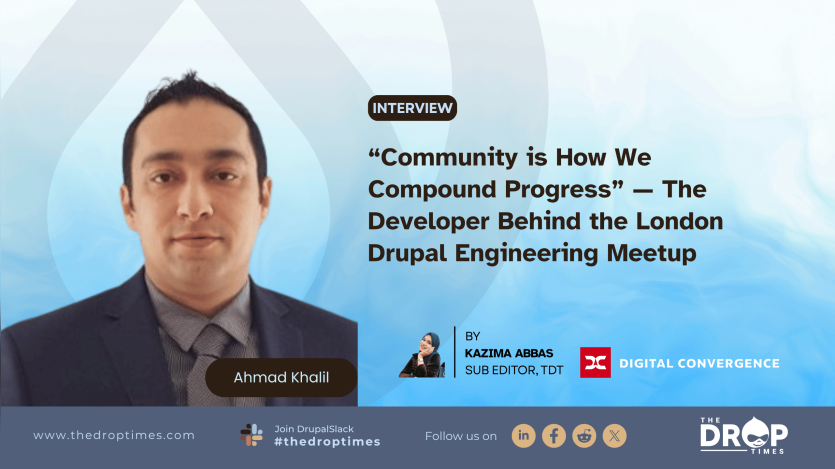
The person behind the successful return of the 2025 London Drupal Engineering Meetup is Ahmad Khalil. He brought the event back with a clear goal: to create a focused space for engineers to connect, learn, and collaborate. At the same time, he’s building CarSouq.net, a Drupal 11 marketplace for the UAE that uses AI-assisted search to make vehicle listings more efficient and accessible.
Ahmad Khalil works remotely from London, Ontario, as a Senior Drupal Developer at Digital Convergence. He’s also the Founder of WebKings.ca, a small Drupal-focused agency. With over 16 years of Drupal experience and more than 25 years in software development, his work spans enterprise systems, component libraries, accessibility, search, and AI-driven tools.
He has led development on major Drupal platforms, including a core system supporting over 500 Boehringer Ingelheim websites. His contributions have included authentication integrations, SEO, analytics frameworks, and fully WCAG-compliant design systems.
In a conversation with Kazima Abbas, Sub Editor at The Drop Times, Ahmad spoke about his plans for the London meetup, the ideas he wants to share with the Drupal community, and his broader contributions to the Drupal ecosystem.
When Ahmad Khalil decided to bring back the London Drupal Engineering Meetup in 2025, it wasn’t for the sake of nostalgia. He saw a gap and acted on it. Developers were deep in the middle of major shifts: Drupal 10 to 11 upgrades, PHP 8.3 readiness, and the rollout of Single Directory Components (SDC). He wanted something focused, useful, and rooted in real project work. So he built the meetup around that idea.
The format is intentionally lean: a one-hour session with a lightning demo, an “upgrade lab,” and live Q&A. It’s structured around real code from CarSouq.net, his own Drupal 11 project. The goal is for developers to walk away with practical, working examples they can use immediately.
As Ahmad explained,
“Two drivers: practicality and belonging. Teams are navigating D10→D11 upgrades, PHP 8.3 readiness, and front-end shifts like SDC. I brought the meetup back as a hands-on, one-hour clinic—a short lightning demo, an ‘upgrade lab,’ and open Q&A. We use live code from CarSouq.net (AI Search, SDC, config discipline) so people leave with copy-pasteable patterns—not slideware.”
He’s not treating the meetup as a standalone event either. Ahmad sees the potential for long-term influence, especially by lowering the barrier to adoption for new technologies.
In his words:
“We’re open-sourcing small, opinionated bundles from CarSouq: a D11 AI Search starter (Search API + embeddings + fallbacks), an SDC scaffold with validation/Storybook, and a composer/platform checklist. That accelerates adoption and fills the ‘last-mile’ gaps teams hit in real delivery.”
One shift in Drupal’s evolution that forced Ahmad to rethink his entire approach to building was the combination of Configuration Management and Composer workflows. Moving configuration into YAML and applying environment-aware config splits significantly changed how he delivers projects. This wasn't just a technical tweak; it reshaped collaboration across teams and environments.
Ahmad’s current standard includes strict config ownership in Git, environment-specific differences managed through Config Split, and CI pipelines that perform pre-flight checks before importing anything.
This emphasis on structured, version-controlled delivery extends to how Ahmad thinks about Drupal itself. For him, Drupal is not just a content management system; it's a framework. A clear example is CarSouq.net, which goes far beyond typical CMS functionality. It's built on Commerce, supports complex workflows, uses moderation queues, applies semantic SEO with structured vehicle data, and includes an AI-powered search feature that parses natural language queries.
“CarSouq.net is an application: Commerce-based listing entities, workflows/moderation, queues for media tasks, semantic SEO (Vehicle schema), and AI-assisted search for make/model/trim in natural language. We rely on services, events, and plugins—classic framework building blocks—to compose clean domain logic.”
That framework-level thinking is also central to how Ahmad handles migrations, especially for clients still on Drupal 7, now officially retired. He doesn’t treat migrations as tickets to close, but as full-scale programs that need structure, predictability, and checkpoints.
The process begins with a full audit using tools like Upgrade Status, mapping out contrib and custom code. From there, his team moves into iterative migrations via the Migrate API, including mapping reviews and dry runs. They then run the new platform in parallel, freeze content when needed, and use delta migrations to capture any last changes.
Working under the hood of Drupal 11 has come with its share of unexpected challenges. Ahmad points out that aligning platform variables, like PHP 8.3 and database versions, across CI, staging, and production environments early on is crucial. Without it, teams run into avoidable failures that burn time and focus. Another issue has been deprecated services that still linger under legacy IDs, which required code refactors to clean up. Adopting Single Directory Components (SDC) also demanded upfront effort, but paid off quickly.
As he explained:
“Platform deltas: aligning PHP 8.3/DB versions across CI, staging, and prod early avoids noisy failures. Deprecated services: refactors were needed where legacy IDs lingered. SDC adoption: initial componentization takes effort; after that, consistency and velocity jump.”
At Digital Convergence, Ahmad wears several hats—balancing architectural planning, direct implementation, and delivery management. He breaks down his typical time split as roughly 40/40/20. The largest chunk goes to architecture and code reviews, defining entity boundaries and enforcing coding standards. Another 40% is hands-on: migrations, performance tuning, search, and accessibility. The remaining 20% is spent on delivery: managing estimates, reducing risk, and unblocking others.
Digital Convergence doesn’t just build projects; it aims to transfer knowledge and best practices into the client’s hands. Their contribution to the Drupal ecosystem is partly through upstreaming code and patterns when permitted, and partly through spreading operational discipline across projects. This includes consistent use of config management, CI with deprecation gates, accessible component systems, and built-in observability.
“Digital Convergence delivers enterprise builds and then transfers operating practices—config discipline, CI with deprecation gates, accessible component systems, and observability. When permitted, Digital Convergence upstreams fixes/patterns. That spreads sustainable Drupal beyond a single project.”
This structured mindset is especially important when juggling Drupal 10 and 11 projects at the same time. Ahmad emphasised how his teams stay aligned and avoid errors through a mix of Composer discipline and CI guardrails. Composer locks are branch-specific and tied to PHP version constraints. CI runs Drupal-Check, PHPStan with the Drupal plugin, and scans for deprecated usage. Config Split manages environment-specific settings. Everything is deployed on release trains that favour predictability and calm cutovers.
Ahmad takes pride in the distinct identity of WebKings, the boutique Drupal agency he leads. That identity isn’t about flashy branding—it’s about disciplined engineering values. Even when working with clients who have strong feature demands, Ahmad and his team push back when necessary to ensure long-term maintainability and user value. Accessibility, performance budgets, and upgrade-safe architecture are non-negotiable.
As he put it,
“We co-author outcomes and measure them. We push back on features that add complexity without user value. Accessibility, performance budgets, and upgrade-safe architecture are non-negotiable, even on tight timelines. The result is software we’re proud to maintain.”
When working with limited budgets, Ahmad’s approach is to build thin but complete vertical slices of functionality. Instead of trying to do everything at once, he prioritises delivering a working flow that covers the full stack authentication, editorial, listing creation, AI search, and caching. He leans on core and well-supported contrib modules, and designs with plugins and events to allow features to be extended later without rewrites. Any shortcuts taken for speed are flagged with a clear plan to revisit them.
Adding new tools or modules isn’t a casual decision for Ahmad. He evaluates based on real metrics: security support, maintainer activity, release frequency, compatibility with current PHP/Drupal versions, and ease of replacement. For AI layers in particular, he adds requirements for graceful fallback behaviour and observability, so that performance degradation is handled gracefully and transparently.
“Security coverage, maintainer responsiveness, release cadence, usage trends, PHP 8.3/D11 readiness, and ease of replacement. For AI layer,s we also require graceful fallbacks, confidence thresholds, and observability (latency/success/quality) so features degrade safely.”
Ahmad has also worked on decoupled and headless projects, but his approach is practical, not hype-driven. He sees great value in decoupling for multi-channel experiences or app-like performance, but warns that previewing, authentication, and cache invalidation must be planned from the start. At CarSouq, they opted for progressive decoupling, which offers better editorial and preview support for now while designing the backend APIs with a future mobile app in mind.
For Ahmad Khalil, community contribution and mentorship are not side activities—they’re built into how he works. Whether he’s guiding developers through complex migrations, helping improve search relevance, or refining component systems, Ahmad actively shares patterns from both client work and CarSouq. Through the London Drupal Engineering Meetup, he stays focused on giving back in a way that’s immediately useful for others.
“It’s central to my work. I mentor on migrations, search relevance, and component systems; I share patterns from CarSouq/client work; and I keep the London Drupal Engineering Meetup focused on takeaways people can apply the next day. Community is how we compound progress.”
Even with his depth of experience, not everything goes smoothly. One example he shared came from an early version of CarSouq’s search functionality, which didn’t perform well on code-mixed Arabic/English queries. Rather than settling for a partial solution, Ahmad and his team made structural changes, adding language detection, Arabic-aware tokenisation, synonym mapping for makes and models, and confidence-based fallbacks that kicked in when the system was unsure. This shaped his broader philosophy around AI features: they must ship with confidence thresholds, fallbacks, and telemetry baked in from the start.
“Early CarSouq search underperformed on code-mixed Arabic/English queries. We added language detection, Arabic-aware tokenisation, synonym maps for makes/models, and a fallback to facets when confidence dipped. The policy change: all AI features ship with confidence thresholds, fallbacks, and telemetry from day one.”
What still keeps Ahmad energised today is the intersection of AI and user experience, especially when it leads to real, frictionless outcomes. He’s also drawn to deep technical work building robust SDC libraries, writing clean APIs, tuning search, and maintaining CI pipelines that support speed without compromising quality.
And that’s exactly the philosophy behind CarSouq.net, Ahmad’s Drupal 11 marketplace for the UAE. Listings are built as Commerce products with structured data for make, model, and trim. It supports Arabic/English search and uses progressive decoupling for a future-ready mobile experience. The project is aiming for public launch later this year, and Ahmad plans to open-source a minimal D11 AI Search Starter based on the lessons learned throughout the build.
Ahmad describes CarSouq.net as both a practical build and a contribution back to the Drupal community:
“CarSouq.net is a Drupal 11 marketplace for the UAE with AI-assisted search. Listings are structured as Commerce products with make/model/trim semantics, Arabic/English search support, and progressive decoupling for a future mobile app. We’re targeting a public launch later this year and will open-source a minimal ‘D11 AI Search Starter’ recipe based on what we’ve learned.”
 Kazima AbbasKazima Abbas is a sub-editor at The Drop Times
ASK: Drupal Community Needs Your Support
View all →
Disclosure: This content is produced with the assistance of AI.
Note: The vision of this web portal is to help promote news and stories around the Drupal community and promote and celebrate the people and organizations in the community. We strive to create and distribute our content based on these content policy. If you see any omission/variation on this please reach out to us at #thedroptimes channel on Drupal Slack and we will try to address the issue as best we can.

Related Organizations


Related People


You may also like